19 Reasons Pink is a Primary Color
The video at the bottom of the page discusses why pink is a primary color.
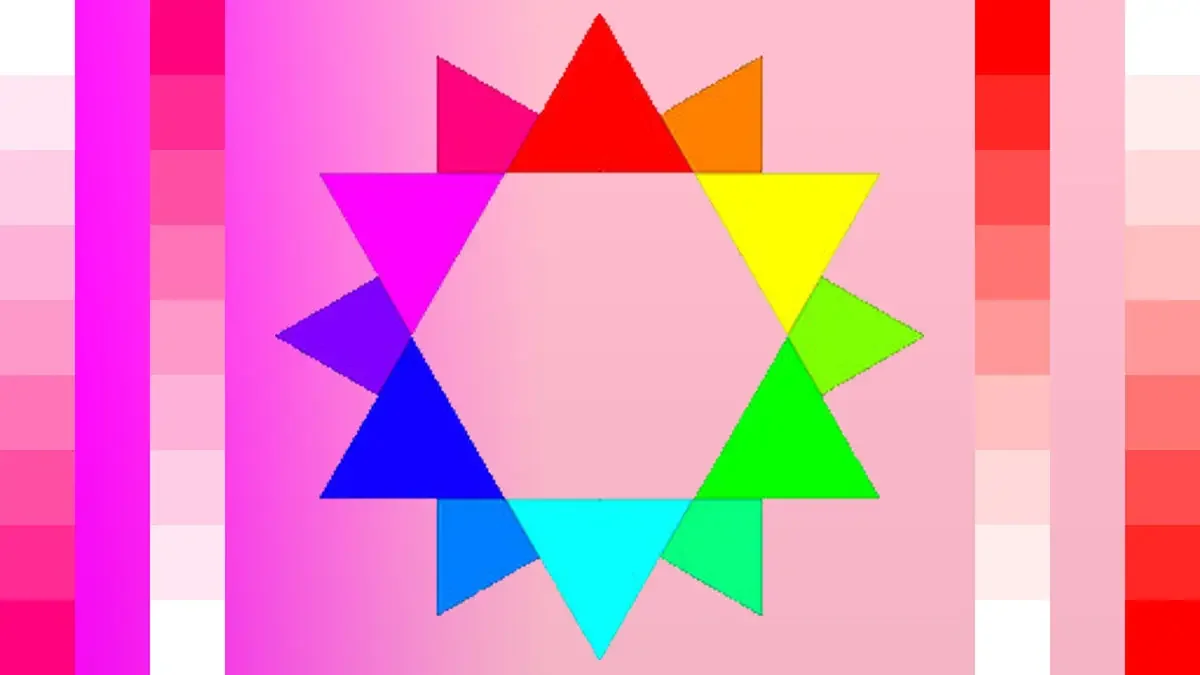
The Identity Argument
Pink is red by another name. A pink stimulus has the same dominant wavelength as red, read differently by the eye under high luminance and low saturation. If pink is red, and red is primary, then pink is primary. No mixing story is needed because there is nothing to mix.
Source: https://en.wikipedia.org/wiki/Shades_of_pink
The Positional Argument
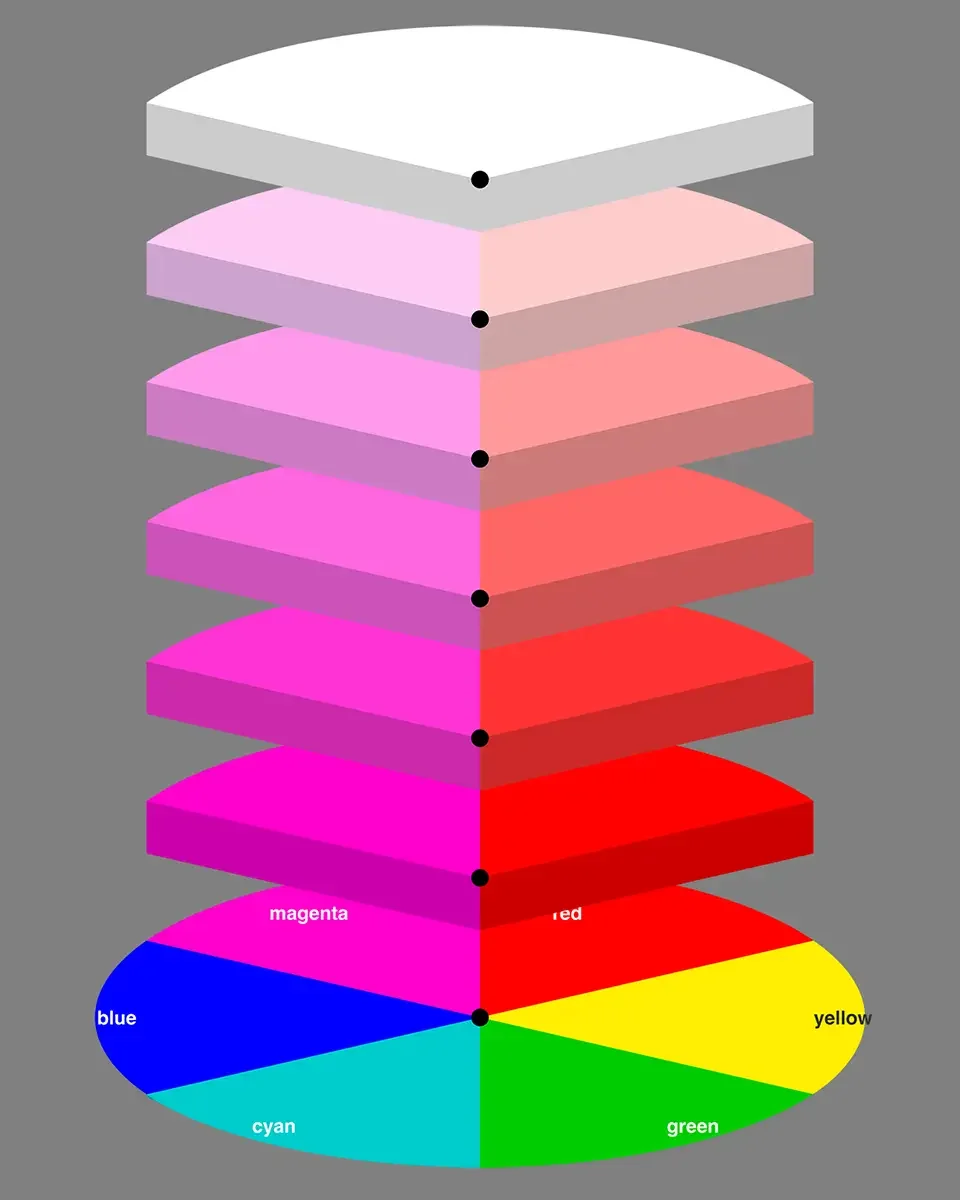
In the CMY subtractive model, the one used in printing, magenta occupies a primary slot, and magenta is a pink. At least one working color model, the one that prints the modern world, already lists a pink among its primaries.
The Elimination Argument
Pink is not a secondary and not a tertiary in any model. If the taxonomy consists of primary, secondary, and tertiary, and pink is neither of the latter two, it falls to primary by exclusion.
Source: https://www.canva.com/colors/color-wheel/
The Irreducibility Argument
A secondary color is defined by being mixable from primaries. On the RYB wheel, no combination of red, blue, and yellow produces pink. You must go outside the wheel, to white, to get it. A color that a model's own primaries cannot produce is not derivative of them.
Source: https://www.decoart.com/blogs/default-blog/color-theory-basics-the-color-wheel
The Extra-Spectral Argument
Pink has no wavelength. Secondaries and tertiaries can be pointed to on the spectrum or derived from spectral neighbors. Pink exists only as a construction of the visual system, along the line of purples on the chromaticity diagram. Something that cannot be decomposed into spectral parts is fundamental in its own right.
Source: https://en.wikipedia.org/wiki/Line_of_purples
The Perceptual-Primitive Argument
Pink behaves like a basic color category in human cognition and language. English speakers treat pink as its own basic color term, like red, blue, and green, rather than as "light red," even though we happily say "light blue" and "light green." Linguistically and psychologically, pink is already primary. Only the wheel disagrees.
Source: https://jov.arvojournals.org/article.aspx?articleid=2137074
The Additive-Light Argument
In additive mixing, red light plus white light, or a red channel at partial intensity on a white-capable display, gives pink directly. Pink is what red is on every screen at less than full contrast. The most ubiquitous color technology in existence renders pink as a first-class state of a primary channel.
Source: https://www.rapidtables.com/web/color/pink-color.html
The Historical-Contingency Argument
The RYB primaries are an artifact of 18th-century pigment availability, not physics. Science later replaced them with CMY and RGB. If "primary" is a moving designation that models revise, pink's exclusion is a legacy of old paint, and the revised models have already let it in.
Source: https://en.wikipedia.org/wiki/RYB_color_model
The Symmetry Argument
Brown is universally accepted as a real color despite being nothing but dark orange or red. If darkened red earns independent color status, then lightened red, which is pink, deserves at least equal standing. And since its parent is primary, so is it.
Source: https://biologyinsights.com/is-brown-just-a-dark-orange/
The Duality Argument
RGB and CMY are formal duals. Each CMY primary is defined as white minus one RGB primary, and magenta equals white light minus green. Colors produced by subtracting a single primary are, by construction, the primaries of the complementary system. Pink and magenta are not grandfathered into CMY. They are mathematically entailed as primary the moment you accept RGB.
Source: https://www.physics.wisc.edu/ingersollmuseum/exhibits/opticscolor/subcolormix/
The Complement Argument
The complement of a primary is a primary in the dual model. Green is a primary in RGB, and its exact complement is magenta. Stare at a green square and the afterimage your visual system produces is pink-magenta. Your own retinas file pink as green's equal and opposite, not as anyone's tint.
Source: https://www.sciencebuddies.org/stem-activities/afterimages-illusions
The Opponent-Process Argument
Human vision runs on three neural channels: red versus green, blue versus yellow, and light versus dark. Pink is the red pole of the first channel firing alongside high output on the luminance channel. It is a pure state of a primary opponent channel, with no cross-channel mixing required, which is more than orange or purple can say.
Source: https://www.simplypsychology.org/what-is-the-trichromatic-theory-of-color-vision.html
The Gamut-Boundary Argument
On the CIE chromaticity diagram, every visible color is a mix of colors on the boundary hull, and the line of purples, the pink-magenta edge, is part of that hull. Boundary colors generate interior colors, while interior colors can never generate boundary colors. Secondaries and tertiaries are interpolations. Pink is a generator, and that is the structural definition of primary.
Source: http://hyperphysics.phy-astr.gsu.edu/HBASE/vision/colper.html
The Unmixability-in-RYB Argument
RYB cannot produce even vivid pink or magenta. Mix red and blue paint and you get dull purple, not fuchsia, which is a famous failure of the RYB gamut. A color family that a model's primaries cannot reach at any saturation is not downstream of that model. It is outside and prior to it.
Source: https://russell-collection.com/what-are-primary-colors/
The Photo-Ink Argument
High-end photo printers use six-ink systems that include light magenta, literally a dedicated pink ink, because dithering full magenta cannot render pinks smoothly. When engineering hit its limits, the fix was to install pink as its own independent channel. Industry practice treats pink as unfakeable.
Source: https://en.wikipedia.org/wiki/CcMmYK_color_model
The Dilemma Argument
The viral claim that pink is not a real color, because it has no wavelength, backfires. It proves pink cannot be placed among spectral secondaries and tertiaries. The skeptic's own premise forces a choice: pink is either nonexistent or fundamental. Since pink is plainly seen, painted, printed, and named, only fundamentality survives.
The Lightness-Shouldn't-Demote Argument
Modern color-order systems such as Munsell and NCS treat hue, value, and chroma as independent axes, and "primary" is a property of hue. Pink shares red's hue coordinate exactly. Demoting pink for its value and chroma position applies a criterion the wheel never applies elsewhere. Nobody says sky blue disqualifies blue's slot.
Source: https://www.britannica.com/science/Munsell-color-system
The Cross-Linguistic Argument
Several languages grant lightness variants full basic-color status. Russian has goluboy for light blue as distinct from siniy, and Italian has celeste. Human color cognition demonstrably allows a light variant to be its own basic color. English did precisely this once, for exactly one hue: pink. The lexicon voted, and it voted primary.
Source: https://sites.socsci.uci.edu/~kjameson/ECST/Hardin_BerlinKayTheory.pdf
The Distinct-Effect Argument
Baker-Miller pink, known as drunk-tank pink, was deployed in holding cells for its documented calming effect, which is the opposite of red's arousing effect. A color that produces its own physiological signature, distinct from and contrary to its supposed parent, is behaving like an independent agent, not a dilution.
Source: https://en.wikipedia.org/wiki/Baker%E2%80%93Miller_pink