Diane Arbus Called Her
the Best in the World.
Critics Called Her "Cheesecake."
Diane Arbus described Bunny Yeager as "the world's greatest pinup photographer." Arbus was not a person who distributed praise loosely or strategically. She was one of the most critically serious photographers working in the 1960s, a figure whose own genre associations, with the marginalized, the transgressive, the socially invisible, did not prevent her from being absorbed into the fine art canon entirely on her own terms. Her assessment of Yeager was peer recognition across genre lines, offered by someone who understood exactly what it meant to work in a category the critical establishment had not yet decided to take seriously.
The critical establishment filed it under cheesecake and moved on.
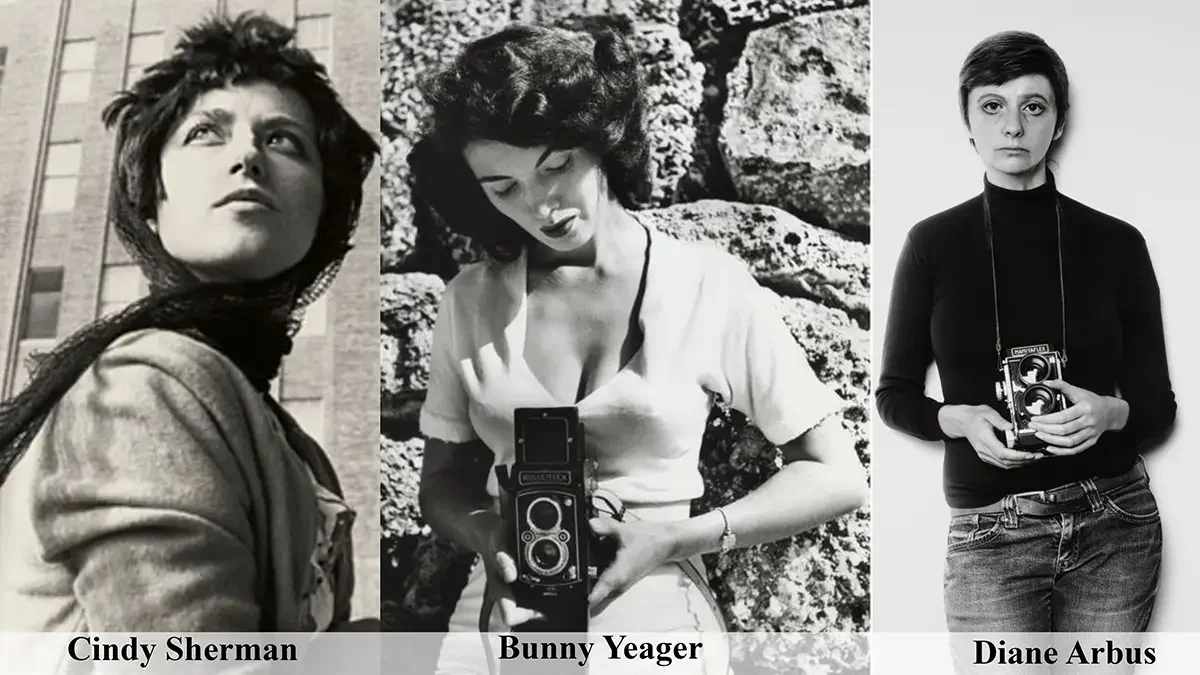
The Evidence Was There
Yeager had the credentials. She had photographed Bettie Page in a series of images that redefined the visual language of pinup photography by giving the subject agency rather than removing it. She had shot eight Playboy Playmates, several of whom she discovered herself. In 1964, she published "How I Photograph Myself," a practical manual for self-portraiture written by a working photographer who had spent a decade developing a visual language for the female body directed by a woman. That book predates the Cindy Sherman "Untitled Film Stills" series by thirteen years and predates the front-facing camera by decades. The people who credit the selfie to smartphones, or feminist self-representation to Madonna, are working from a very short history and fail to recognize the work of Yeager, Sherman, and Arbus.
Sherman herself cited Yeager as a major influence. That is not a footnote. Sherman's "Untitled Film Stills," begun in 1977, is one of the foundational texts of postmodern self-representation: a woman constructing and deconstructing female identity through the camera, using herself as raw material. In 2013, the Andy Warhol Museum mounted "Regarding Andy Warhol: Sixty Artists, Fifty Years," built around the argument that Warhol's influence on contemporary art was broader and deeper than any prior exhibition had documented. Sherman was in it. The exhibition did not mention Bunny Yeager once.
The Classification Problem
Modernism and Surrealism document a pattern the history of photography has repeated without fully examining. Radical visual experimentation gets produced, absorbed by a commercial or popular context, and then recovered by the fine art world years or decades later, usually with the intermediate commercial phase quietly edited out of the lineage. Man Ray's solarization technique moved from Surrealist experiment to fashion advertising without anyone calling it a demotion. Paul Outerbridge and George Hoyningen-Huene worked inside commercial fashion contexts and are now treated as part of the modernist photographic canon. The traffic between commercial and fine art photography runs in both directions. The critical map only draws it one way.
Yeager's trajectory ran the same route in reverse. She worked inside a commercial genre, developed a technically rigorous and visually original practice, produced self-portraits that a major fine art photographer credited as formative, and received serious institutional recognition only after her death, and then only partially and without her name attached to the lineage she had directly shaped.
The word "cheesecake" did a lot of work in that process. It named a genre. It also issued a verdict. Genre classifications in photography have never been neutral. Pictorialism was dismissed as painterly and soft when the critical establishment decided that straight photography was the more serious practice. Documentary photography was treated as journalism rather than art until the museums decided otherwise. The classification system determines what gets examined and what gets filed, and it has consistently filed commercial and popular genres as lesser, regardless of the quality or influence of the work being produced inside them.
Peer Recognition Is Not Enough Without Infrastructure
The Dada and Surrealist figures who made it into the fine art canon did so partly through peer recognition within networks that had institutional reach. The late 19th & early 20th centuries made this visible. Stieglitz championed straight photography through his gallery and his publications. The Bauhaus gave Moholy-Nagy a platform that connected his ideas to architecture, design, and commercial production simultaneously. Hannah Höch's photomontages were exhibited alongside the work of the men who surrounded her in the Dada movement, even when the movement's own internal politics tried to exclude her.
Yeager had the peer recognition. Arbus gave it to her directly, and in terms that left no room for qualification. What she did not have was a network that moved that recognition into the institutional record while she was alive and working. By the time the Andy Warhol Museum was tracing the lineage of self-representation from Warhol through Sherman, the critical vocabulary for that argument had been built around Sherman's work, not Yeager's. Mentioning Yeager would have required the exhibition to explain why it had taken this long to mention her.
What the Canon Owes the Record
Yeager died in 2014 at eighty-five. The Warhol Museum had presented an exhibition of her self-portraits in 2010. The Museum of Art in Fort Lauderdale mounted a career retrospective in 2013. The critical establishment was, slowly, doing the work. But the Warhol exhibition that placed Sherman inside a fifty-year lineage of influence running through contemporary art's most canonical figures did not circle back to name the photographer Sherman said shaped her.
That omission is not accidental and it is not innocent. It is the product of a classification system that decided, decades ago, that cheesecake was a commercial genre and therefore not a critical one, and has been living with the consequences of that decision ever since. The consequences include a Cindy Sherman lineage that begins with Warhol and leaves out the woman who published a self-portrait manual thirteen years before Sherman picked up a camera.
The evidence was always there. The classification system chose not to read it.