Kodak Lowered the Skill Floor.
Artists Raised the Ceiling.
Two articles about the art world are making the rounds right now, and they're both half right in a way that quietly cancels out.
TIME argues that AI is going to push human artists toward performed amateurism: mistakes as the new mark of talent, polish as a red flag. Art Meets Culture argues the opposite: that 2026 is the year of a durable market swing toward craft, texture, and the visible hand, and that collectors will keep paying a premium for it.
I've spent a career photographing commercially and teaching the history of this medium, and I can tell you which of these claims the record actually supports, and which one is about to get eaten by the market it's celebrating.
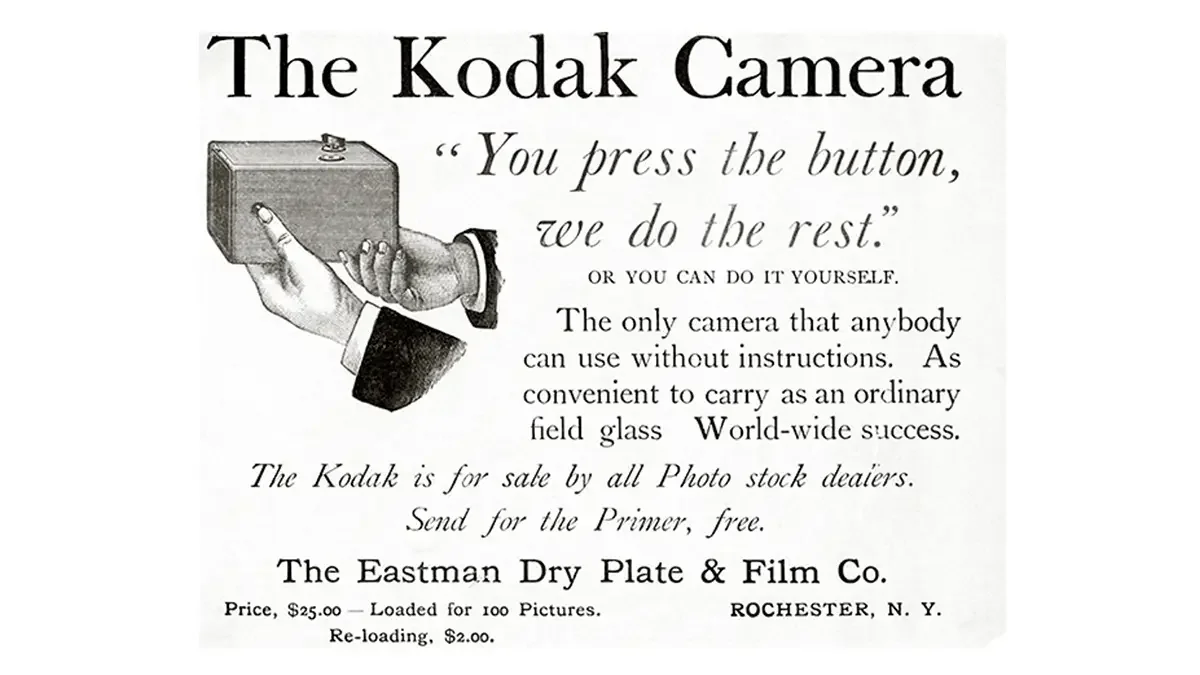
The Kodak Precedent
In 1888, Kodak put a camera in the hands of anyone who could press a button. The company's own slogan promised the machine would do the rest. For the first time, technical skill stopped being the barrier between a photographer and a picture, which is precisely the crisis TIME describes for AI, just with a different tool.
The serious photographers of that moment didn't respond by getting worse. I cover this in Module 06 of my History of Photography course: the Pictorialist movement that formed in direct response to the Kodak snapshot flood went the opposite direction. Gum bichromate printing, soft-focus lenses, combination printing, hand-manipulated negatives, techniques so labor-intensive that critics of the era debated for decades whether a photograph was even allowed to look that deliberately crafted. The Met's overview of the movement and TheArtStory's summary of Pictorialist technique both make the same point in more detail: Alfred Stieglitz's circle didn't preserve an "untrained, uninformed spirit," to borrow TIME's phrase. They pursued a level of technical virtuosity that took years to master, specifically so their work couldn't be mistaken for a snapshot.
That's the actual historical pattern. When a machine floods the world with easy images, the professional response has been to make craft more visible, not less. TIME's prediction, that AI will make artists want to look worse on purpose, inverts a pattern that's already been tested. It didn't hold in 1888, and there's no clear reason it holds now.
What Actually Happened to Painting
TIME leans on the famous, probably apocryphal quote from painter Paul Delaroche, who is said to have declared "painting is dead" upon seeing a daguerreotype around 1839. The piece credits the ensuing photography-versus-painting anxiety with producing Impressionism, Fauvism, and Cubism, three movements that in fact emerged across a 70-year span, shaped by industrialization, the collapse of academic patronage, and eventually the trauma of two world wars, not by photography alone. The Barnes Foundation's exhibition on this period documents just how gradual and contested that transition actually was.
I walk through this in more depth in Module 01 of my Modern Art course, because the compression matters. It lets TIME borrow the credibility of a real historical pattern (technology forces a medium to redefine itself) while smuggling in a conclusion the history doesn't support (that redefinition looks like deliberate incompetence). Painting didn't survive photography by getting worse at painting. It survived by doing something a camera couldn't: representing the world subjectively, then eventually abandoning representation altogether. That's a move toward a different kind of mastery, not away from mastery itself. Module 03 covers exactly how that shift played out from Impressionism through Art Nouveau, and it wasn't a retreat into rawness. It was a sharpening of ambition.
Where Art Meets Culture Gets It Half Right, and Half New
Art Meets Culture's underlying observation is sound. Image saturation does push part of the market toward visibly hand-made work. But it frames this as a 2026 discovery, when it's closer to the third run of a pattern that's at least 170 years old. I cover the first run in Module 03 of my History of Photography course: the carte-de-visite boom of the 1850s flooded the world with cheap, mass-produced portraits, and in response, photographers with artistic ambitions built elaborately staged, hand-combined images designed to look like paintings, specifically to separate themselves from the flood.
Mass, cheap production splits a market into a commodity tier and an elevated-craft tier. That's not a 2026 recalibration. It's what happens every time, and it's worth naming plainly because it changes what "craft revival" actually predicts: not a permanent cultural shift toward authenticity, but a new luxury tier that borrows legitimacy from whatever is currently under threat.
The Market Doesn't Protect Meaning. It Monetizes the Gesture.
Here's the part neither article grapples with. Even if the craft signal is real, nothing in this field's history says the market lets it stay meaningful.
Basquiat's raw, anti-institutional mark-making sold for $19,000 at Christie's in 1984. By 1998 a single drawing broke seven figures. By 2017, a painting sold for $110.5 million, and auction totals have kept climbing since. The market didn't reject his resistance to institutional polish. It spent three decades pricing that resistance in, until "looks like it fought the establishment" became one of the most bankable qualities a contemporary painting could have.
Or take Cindy Sherman's Untitled Film Stills, which spent forty years demonstrating that identity in a photograph is a constructed performance, not a captured truth: the "self" as a set of borrowed guises, not an authentic core. Postmodernism's entire critical project was built on the claim that authenticity is a style choice, not a state of being. I cover this shift, and what came after it, in Module 06 of my Modern Art course and in Module 12 of my History of Photography course, which traces the same pattern into the smartphone era. This field already had the theoretical tools to see this coming.
If craft-as-authenticity becomes 2026's dominant signal, expect the same arc: real work by artists who mean it, followed by a market that learns to manufacture the appearance of meaning faster than anyone can police the difference. Assuming this time is exempt from that pattern isn't optimism. It's just not checking the record.
What This Actually Means for Working Artists
Two conclusions, not one.
TIME is wrong about the mechanism. AI saturation won't push serious artists toward performed incompetence. History's actual answer to a flood of easy images has always been more visible mastery, not less. Build the skill that can't be faked, the way Stieglitz's circle did.
Art Meets Culture is wrong about the durability. The craft signal is real right now, but "authentic" is not a fixed identity in this market. It's a style that gets priced the moment it's legible, the way Basquiat's rebellion and Sherman's constructed selves both eventually were. The advantage isn't in having craft. It's in the years before the market finishes pricing it.
Resources referenced in this piece
The two articles under discussion
TIME, "How AI Will Make Art Worse", June 26, 2026
Art Meets Culture, "The Art World in 2026: What's Coming Next?"
On Pictorialism and the Kodak-era crisis
The Met, "International Pictorialism"
The Met, "Faking It: Manipulated Photography Before Photoshop"
TheArtStory, "Pictorialism Movement Overview"
On the photography-versus-painting anxiety of the 1840s
Smithsonian Institution Archives, "Photography Murdered Painting, Right?"
Art Eyewitness, "From Today, Painting Is Dead: Historic Photos at the Barnes Foundation"
On market absorption of anti-institutional work
Guy Hepner, "The 10 Most Expensive Jean-Michel Basquiat Paintings"
MyArtBroker, "Jean-Michel Basquiat Value: Top Prices Paid at Auction"
From my own education courses
History of Photography, Module 03: Art vs. Commerce and the Rise of High Art Photography
History of Photography, Module 06: Pictorialism and the Fine Art vs. Mass Media Divide
History of Photography, Module 12: Postmodernism, Digital Photography, and the Smartphone Era
Modern Art, Module 01: What Is Modern Art?
Modern Art, Module 03: Impressionism, Post-Impressionism, Symbolism, and Art Nouveau
Modern Art, Module 06: Contemporary Art
Full course outlines: History of Photography and Modern Art