Kusama's Infinity Nets Sat Between Pollock and Judd. The Survey Chose Not to Notice.
Roberta Smith settled the charlatan question with 76 canvases from 2017. Five from 1959 would have done it, and they sit exactly where the textbook story of Pollock, Warhol, and Judd turns.
When Yayoi Kusama passed away on August 14, the tributes reached for the mirror rooms, the pumpkins, and the polka dots, and most of them reached for a sentence Roberta Smith wrote in 2017 about whether Kusama was the greatest artist of the 1960s or a bit of a charlatan. I want to answer that question, but not with the rooms, and not with the paintings Smith used. I want to answer it with four objects made between 1959 and 1966, each in a medium I'll name as we go, and with the observation that the survey text I teach from tells a three-part story about those exact years without ever mentioning that she was there for all three.
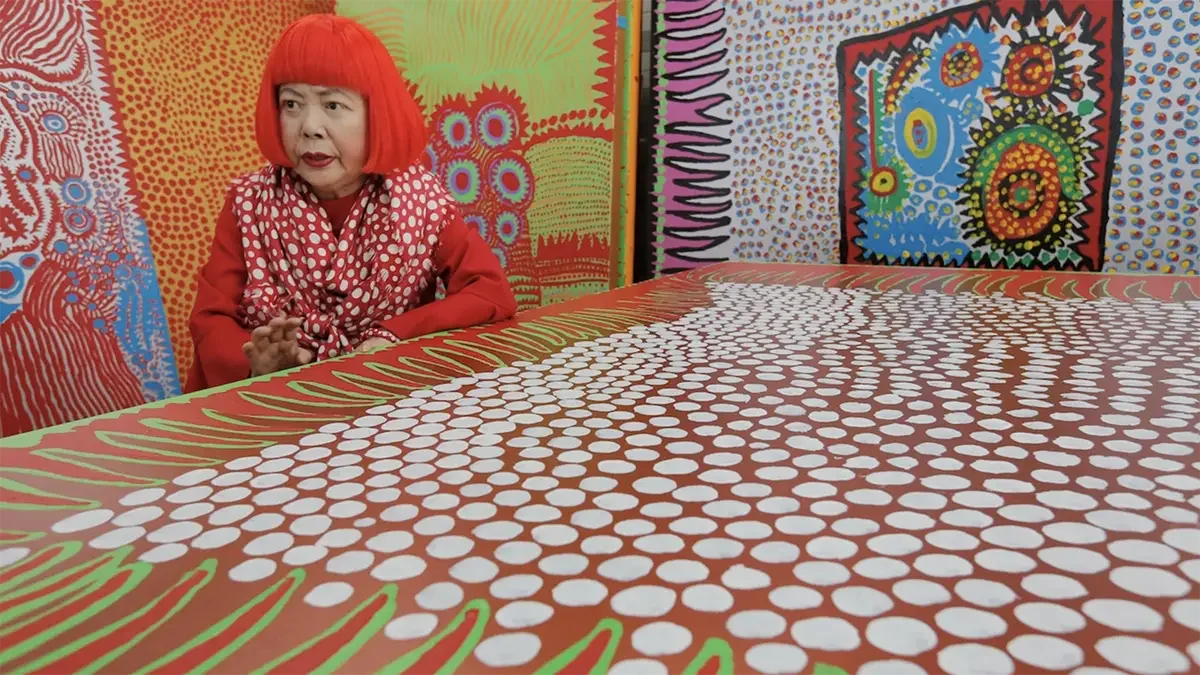
AP Photo / Itsuo Inouye
Roberta Smith Answered Her Own Charlatan Question. She Used the Wrong Evidence.
In November 2017, reviewing Yayoi Kusama's exhibitions at David Zwirner for the New York Times, Roberta Smith wrote the sentence that has followed Kusama ever since. Sometimes, she said, she thought Kusama might be the greatest artist to come out of the 1960s. Other times she thought Kusama was “a bit of a charlatan who produces more Kusama paintings than the world needs” and stoops to conquer with mirror rooms full of people photographing themselves.
Most of the tributes published since Kusama passed away on August 14 quote the first half of that sentence and the word charlatan, and then treat the question as open. It was not open. Smith closed it in her next paragraph. The Zwirner shows included 76 works on canvas, and on the strength of that wall she came down on the side of greatness.
I agree with her verdict. I disagree with her evidence. Seventy-six paintings made in 2017 prove that a woman in her late eighties could still fill three galleries. That is fertility. It answers the overproduction charge by conceding it and calling it a virtue, and there is a real argument there, but it isn't the argument that settles the question. The evidence that settles it is five paintings from 1959, oil on canvas, white on a dark ground, shown for three weeks at an artist-run gallery on Tenth Street. Those five canvases sit at the exact point where the standard narrative of postwar American art changes direction, and the narrative has spent sixty years stepping around them.
The Sequence Every Survey Teaches: Pollock's Gesture, Warhol's Factory, Judd's Object
Every survey of modern art tells the same story about the years between 1950 and 1966, and the survey text I teach from tells it well. Beat one: Jackson Pollock, enamel poured onto unstretched canvas, the artist's body as the instrument and the artist's inner life as the subject. Beat two: Andy Warhol, silkscreen on canvas, the artist removed, the commodity elevated, the Factory as a satiric inversion of the studio. Beat three: Donald Judd and Frank Stella stripping away both Pollock's turbulence and Warhol's irony until what remains is the object, industrial materials and plain declarations, what you see is what you see.
It's a good story. It's teachable. Each beat corrects the excess of the one before it, and the student comes away with a clean three-step account of how American painting became American sculpture. The survey's entry on Kusama, when it arrives at all, lands in a later chapter under abstraction, alongside Anselm Kiefer and El Anatsui, described as brightly colored polka-dot acrylics with roots in Biomorphic Surrealism and Pop. That is a description of the work she was making in 2010, filed a hundred pages after the argument it belongs to.
Survey texts do this for understandable reasons. They select artists who are already canonical, because a survey's job is to transmit consensus, not to make it, and then they add a measure of controversy where space allows so the account doesn't read as settled. The cost is that an artist who was in the room for all three beats, and whose work answered each of them in turn, gets a blurb where she needs a chapter. The rest of this piece is that chapter, told through four objects and their dates.
1959: Judd Reviews Five White Canvases and Names Rothko, Still, and Newman, Not Pollock
Kusama's first New York solo exhibition ran at the Brata Gallery from October 9 to 29, 1959. Five paintings, oil on canvas, each very large, each a field of small white arcs laid over a dark ground and then washed with white until the arcs and the ground began to trade places. She called them Infinity Nets. The stated ambition, which the Museum of Modern Art still quotes on its collection page, was to cover the entire world.
Donald Judd had been hired as a reviewer by ARTnews in September of that year. In his second month on the job he reviewed the Brata show, and the review opens by calling Kusama an original painter. He describes the space as shallow and close to the surface, produced by two nearly parallel planes that merge where the interstices are whitened and diverge where the strokes widen. He compares the total effect to a massive, solid lace. And then he places her. She is something of Rothko, Still, and Newman, he writes, but the work is “not at all a synthesis and is thoroughly independent.”
Read that placement carefully, because it's the placement that matters. Judd does not mention Pollock. The painter who would become the third beat of the survey sequence, looking at these canvases in the month they were shown, measured them against the color-field painters and found them independent of even those. He bought one of the five for two hundred dollars, paid in four installments. Two years later, writing to the immigration service in support of her residency, he described the five paintings as having been recognized as exceptional.
The Pollock reading came later and it came from art historians. Mignon Nixon, in the Tate Modern catalogue for the 2012 retrospective, argues that the large Nets parodied Pollock's excess and answered the masculine performance of Abstract Expressionism with a repeated, nearly identical mark that refuses to be a gesture at all. I find that reading persuasive, and anyone who has spent a week repeating the same small stroke across a large surface knows what it does to the ego: it removes the ego from the transaction. The hand keeps going after the self has stopped narrating. Kusama had a name for that. She called it self-obliteration, and the Nets are where the term was earned before it was coined.
So by 1959 the first beat of the sequence has already been answered. Pollock's gesture, the artist's body as the subject, has been replaced by a mark that erases the body through repetition. Judd saw it. The survey did not.
1962: Accumulation No. 1 Hangs at Green Gallery Beside Warhol, in the First Pop Show
Accumulation No. 1 is an armchair. Kusama covered it with hand-sewn stuffed fabric phalluses, painted the result, and left the chair fringe visible along the bottom. The Museum of Modern Art, which owns it, lists the medium as sewn stuffed fabric, paint, and chair fringe, and dates it to 1962. It was her first sculpture.
Here is what the survey narrative has to reckon with. Richard Bellamy put Accumulation No. 1 in a group show at the Green Gallery in 1962 alongside Claes Oldenburg, James Rosenquist, George Segal, and Andy Warhol. That exhibition is generally counted as the first Pop show in the United States. Kusama's chair was in it. The second beat of the sequence, Warhol's arrival, the commodity carried into the gallery, has Kusama physically present at its opening night with a domestic object that has been made unusable by the artist's hand.
There's a further claim, and MoMA handles it exactly as I intend to. Kusama made the piece in a loft in the same building as Oldenburg's studio, and she maintained that Accumulation No. 1 was the source of his subsequent soft sculptures. MoMA calls that open to debate, and then states what is not debatable: the chair is an early example of soft sculpture, and it predates the work that made Oldenburg famous. I'll leave the attribution question where the museum leaves it. The chronology needs no advocate.
What the chair does to the survey's second beat is subtler than a precedence dispute. Warhol's answer to Pollock was to remove the hand and let the silkscreen do the work. Kusama's answer was the opposite. She kept the hand and multiplied it, hundreds of sewn forms, each one a decision, until the object under them disappeared. The commodity is not elevated. It is buried. That is a third position between the gesture and the factory, and it was on view in 1962, in the show the textbooks cite as Pop's beginning.
1965: Phalli's Field Puts the Viewer Inside the Object
Infinity Mirror Room, Phalli's Field was shown at the Castellane Gallery in New York in 1965, in an exhibition Kusama titled Floor Show. The medium, per the exhibition record, is sewn stuffed cotton fabric, board, and mirrors. It's a small room. The floor is carpeted with the same stuffed forms that covered the armchair, now painted with red dots, and the walls are mirrors. You step in and the field extends past every horizon, with you in it.
This is the origin of everything that later drew half a million people to the Hirshhorn in a single run. It is also the year Judd published “Specific Objects,” the essay that argued for work that was neither painting nor sculpture but a thing in real space, encountered by a body. Phalli's Field is a specific object with the viewer inside it. Judd's boxes asked you to walk around them. Kusama's room asked you to walk in and then took away the outside.
That's the third beat of the sequence, answered in the same year it was declared. The survey teaches Minimalism as the moment art stopped referring to anything outside itself. Kusama built a room that stopped referring to anything outside itself and put you in the middle. The object didn't lose the viewer. It swallowed her.
I want to be careful about what I'm claiming. I am not claiming Kusama was a Minimalist, or a Pop artist, or a late Abstract Expressionist. I'm claiming the reverse: that each of those labels fits one of her objects well enough that the survey's three-beat story could have been told through her alone, and that the reason it wasn't is that she would have collapsed the beats into a single artist. A sequence needs distinct figures. Kusama refused to be only one of them.
1966: Narcissus Garden Sells the Charlatan Charge Back to the Biennale for $2
The charlatan half of Smith's sentence deserves its own object, because Kusama made one for it.
In June 1966 she arrived at the 33rd Venice Biennale without an invitation and laid 1,500 mirrored plastic spheres on the lawn outside the Italian Pavilion. She put up two signs, one naming the work and one reading, in her spelling, Your Narcissium for Sale, and she sold the spheres to passersby for 1,200 lire, about two dollars, while handing out flyers reprinting the critic Herbert Read's praise of her work. Biennale officials stopped the selling. The installation stayed. Smarthistory's account, which is the cleanest institutional summary of the event, reads the transaction as a demonstration of the economic system that art production and exhibition sit inside.
If you want to call that a stunt, you can. It was one. It was also the first work in which the mirror did what the mirror does in every room she built afterward: it made the viewer the subject and then sold the viewer the evidence. The title is not coy. Narcissus is the person looking. Two dollars was the price of seeing yourself, and the Biennale, which had not paid her anything, found the price offensive.
The reason this matters for the charlatan question is that the charge only lands if self-promotion is disqualifying, and the survey has already ruled that it isn't. Warhol is the second beat of the sequence precisely because he made self-promotion into the work. Kusama did the same thing three years before the Factory became a brand, did it uninvited, in a gold kimono, on the lawn of the most institutional exhibition in Europe, and did it with a work whose subject was the transaction itself. Either both of them are charlatans or neither is. The survey has picked its answer for Warhol. It owes Kusama the same one.
She returned to Venice in 1993 as Japan's official representative. The mirrored spheres, recast in stainless steel, have since been installed at museums on three continents. The two-dollar price is the part everyone remembers, and it should be. It was the argument.
The Mirror Rooms Prove Reach. The 1959 Nets Prove Position.
The mirror rooms are where most people met Kusama, and they are where the charlatan question gets asked, so I'll say what I think they prove and what they don't.
They prove reach. The Hirshhorn's 2017 run of six rooms drew the museum's largest attendance in forty years. Galleries reported waits of several hours for a minute inside. The rooms were, for a great many visitors, their first encounter with a museum of modern art, and the images they carried out multiplied across every platform that could hold them. Mika Yoshitake, who curated that show, told PBS NewsHour that Kusama intended the work as communal and that the endless reposting of one's own image inside it repeats the very mechanism the rooms were built on. I think that's right, and I also think it's beside the point. Whether a photograph taken inside a mirror room fulfills self-obliteration or contradicts it is a question about the audience. It tells you nothing about whether the artist was any good.
What tells you that is position. Not how many people stood in line, but where the work stood in relation to the work around it when it was made. And on that measure the case is finished before the first mirror room was built. In 1959 she answered Pollock with a mark that erased the hand's owner. In 1962 she answered Warhol with a commodity buried under the hand's labor, in the show that gave Pop its name. In 1965 she answered Judd with an object you could not stand outside of. Three beats, three objects, three dates, each one inside the window the survey uses to tell its story, and each one a position no one else in the sequence occupied.
Smith was right to land on greatness. She would have been right on less evidence. Five white canvases, three weeks, Tenth Street, and a review by the man who would later be taught as the end of the story, telling anyone who read ARTnews that the beginning of it was hanging at Brata.
Where This Comes From
Understanding Modern Art, Module 05: Post-War, From Paris to New York (Pollock, Warhol, Judd, and Stella)
Understanding Modern Art, Module 06: Contemporary Art (the Kusama entry, under Representation and Abstraction)
Donald Judd, “Reviews and previews: new names this month,” ARTnews, October 1959. Full text republished by ARTnews
Judd Foundation, “Donald Judd and Yayoi Kusama”, including the review draft, the $200 purchase, and the 1961 letter to the immigration service
Museum of Modern Art, Accumulation No. 1 (1962), collection record
Museum of Modern Art, “Yayoi Kusama's Return to MoMA”, on the 1962 Green Gallery show and the Oldenburg question
See the Work
Museum of Modern Art, Yayoi Kusama artist page, 112 works online, including No. F (1959), oil on canvas, one of the white Nets from the year this piece is built on
Whitney Museum of American Art, Yayoi Kusama artist page: Air Mail Stickers (1962), Accumulation (c. 1963), and Fireflies on the Water (2002), with images
Tate, Yayoi Kusama artist page: The Passing Winter (2005), Infinity Mirrored Room, Filled with the Brilliance of Life (2011/2017), and Chandelier of Grief (2016/2018)
The Broad, Infinity Mirrored Room, The Souls of Millions of Light Years Away (2013), wood, metal, glass mirrors, plastic, acrylic panel, rubber, LED lighting system, acrylic balls, and water
Further Reading
Roberta Smith, “Yayoi Kusama's Festival of Life,” The New York Times, November 3, 2017. Paywalled. The passage quoted above is also reproduced on the website of Victoria Miro, a gallery that represents Kusama, which is why the original is linked here.
Mignon Nixon, “Infinity Politics,” and Jo Applin, “I'm Here, but Nothing: Yayoi Kusama's Environments,” in Yayoi Kusama, edited by Frances Morris, Tate Publishing, 2012. Print only.
Midori Yamamura, Yayoi Kusama: Inventing the Singular, MIT Press, 2015. The book-length study that reads the work through its milieu rather than its maker's biography.
Midori Yamamura, Yayoi Kusama: Accumulation No. 1, MoMA One on One series, 2026.
PBS NewsHour, “Selfies as communal experience at Yayoi Kusama's Infinity Rooms,” 2017, with Mika Yoshitake's comments
The Washington Post, “Kusama was an artist of self-obliteration. The public made selfies her legacy,” August 27, 2026. Paywalled; read from the accessible portion only. It argues the reception side of the question this piece sets aside.
CNN, “For better or worse, Yayoi Kusama's Infinity Mirrors reshaped the world,” August 28, 2026. Source for the Hirshhorn attendance figure. CNN misquotes Smith's line as “hoards” and characterizes her as undecided; the original is linked above.