You're Not Buying a Headshot. You're Buying an AI Composite.
The ad promises professional results in minutes. What it doesn't mention is what the tool actually does with your face, who owns what comes back, and what you're responsible for when you use it.
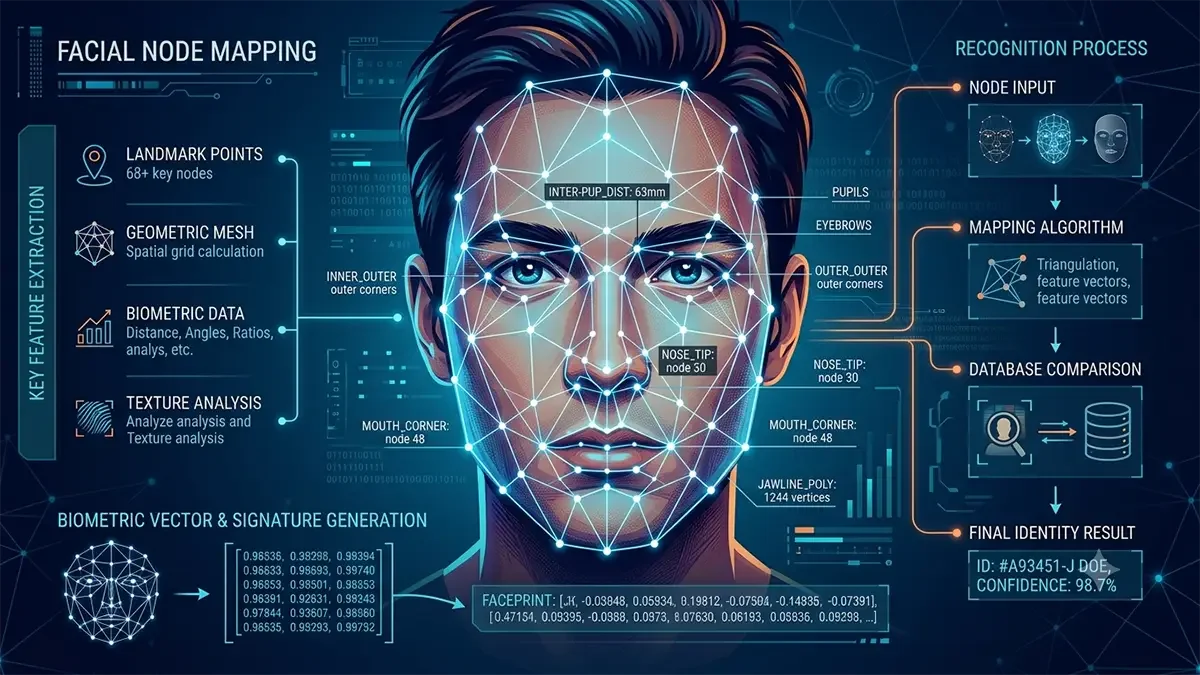
When you hire a photographer for a headshot, a shutter opens. Light hits a sensor. The image corresponds to you, on a specific day, in specific conditions. When you use an AI headshot generator, none of that happens. You upload a handful of selfies. The system extracts data points from your inputs and extrapolates a face. What comes back is a statistical composite. There was no original capture. The image is plausible. The system used your face to build something that isn't your face.
That distinction matters more than the marketing suggests.
Francis Galton Was Doing This in 1880
Francis Galton believed he could extract the essence of a type from a set of individual faces. He overlaid portraits of criminals, soldiers, the sick, and the healthy onto a single plate, producing composite images that looked like real people but corresponded to no single one of them. He called the results pictorial statistics. They were an early exercise in what we now call machine learning: multiple inputs, one extrapolated output, no original.
Galton's composites were scientifically discredited. The eugenics program they were built to support was morally catastrophic. But the operation itself, the statistical extraction of a plausible face from a set of captures, is precisely what an AI headshot generator does with your selfies. The technology is different. The logic is identical.
Galton's composites looked like people. They corresponded to no one. That is worth sitting with before you hand your face to a system doing the same thing.
The Frameworks That Exist Weren't Built for This
California's AB 723, which took effect January 1, 2026, requires disclosure when a real estate photo has been digitally altered, along with a link to the original unaltered image. Florida's Chapter 475 requires that an agent's headshot not be materially misleading, meaning a client should recognize you in person.
Both frameworks assume the same thing: a photograph was taken. There is an original. The question is how far the finished image departs from it.
An AI headshot generator makes that assumption false. There is no original. The image was extrapolated from your inputs and produced as a statistical composite. California's disclosure requirement has no original to link to. Florida's recognition standard is being applied to an image that was never a capture to begin with. The regulations were not written for this category of image. They have no answer for it.
Three Problems the Ad Didn't Mention
You don't own the output.
In March 2025, the D.C. Circuit ruled that the Copyright Act requires a human author for copyright protection. The Supreme Court declined to review the case in March 2026, making the ruling apply nationwide. A purely AI-generated image has no copyright owner. Not you. Not the company that ran your selfies through their system. What the company does own is spelled out in their terms of service, which you agreed to when you signed up. Those terms vary. Most of them are broad.
Your likeness rights are unresolved.
If the output is you, you may have a likeness claim. If it isn't you, because it's a statistical composite extrapolated from your inputs rather than a photograph of your face, that claim becomes harder to establish. Hollywood has been fighting this exact problem since the 2023 SAG-AFTRA strike, when performers reported their body scans and likenesses were being stored for AI reuse without clear terms or additional compensation. Union members eventually negotiated protections. You, as a private professional buying a nineteen-dollar headshot package, negotiated nothing.
The gap between those two positions is where exposure lives.
If you present the composite as your professional photograph and a client later argues it is materially misleading, you are defending an image you don't own, that may not legally be you, under frameworks that weren't written for it. The company that sold it to you is not in that conversation.
What the Marketing Left Out
The ads for AI headshot generators are good. They show polished results. They emphasize convenience and price. They do not explain that the output is a statistical composite with no original capture. They do not explain the copyright status of what you're receiving. They do not explain what the company's terms of service permit them to do with the face data you uploaded. They do not mention that the regulatory frameworks currently in place were built for photographs, and that this is not one.
None of that information is hidden. It is in the terms of service, in the case law, and in the gap between what is being sold and what is being delivered. The marketing just doesn't put it in the ad.
Before you hand your face to one of these systems, it is worth understanding what you are actually purchasing. A headshot is a professional representation. It is used to establish identity and build trust with clients, employers, and colleagues. What an AI headshot generator produces is plausible. It is not that.
Where This Comes From
History of Photography, Module 05: Photography, Science, and the Myth of Objectivity — scottparkerphoto.com/history-of-photography/course-outline
Further Reading
Thaler v. Perlmutter, U.S. Court of Appeals, D.C. Circuit (March 2025); Supreme Court cert. denied March 2026 — the controlling case on AI copyright and human authorship. constitutioncenter.org
California AB 723 (2025), Business and Professions Code § 10140.8 — disclosure requirements for digitally altered real estate images, effective January 1, 2026. leginfo.legislature.ca.gov
Florida Statutes, Chapter 475.25 — "false, deceptive, or misleading" advertising standard governing Florida real estate marketing. flsenate.gov
SAG-AFTRA 2025 Commercials Contract — digital replica consent and likeness protections negotiated by union performers. sagaftra.org