Personal Branding:
Disdéri Sold Scale, Hurrell Sold Production
Personal branding photography joins two older histories: the cheap, standardized carte de visite and the fully produced celebrity portrait. Norma Shearer’s 1929 session with George Hurrell shows the two meeting long before anyone used the term.
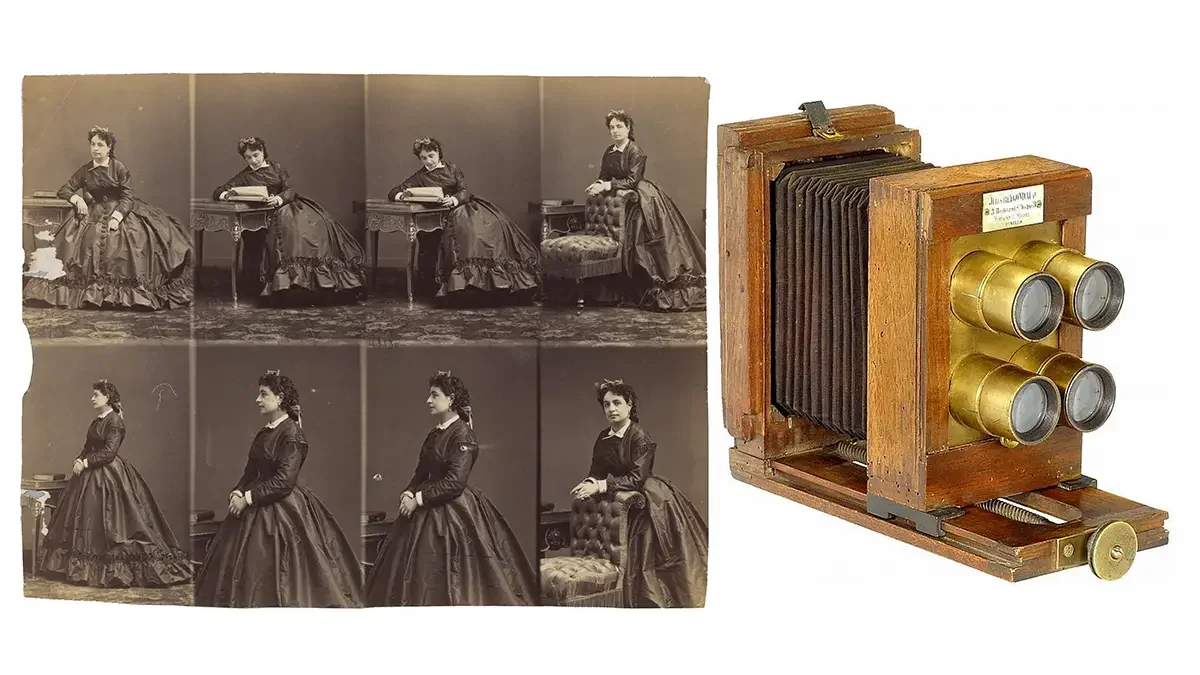
André-Adolphe-Eugène Disdéri charged 20 francs for twelve portraits at a time when a single print had cost 50 to 100 francs. The carte de visite, a small albumen print mounted on card, put the sitter in the commissioner’s seat at a price the lower middle class could pay. What it did not offer was production. The backdrop, the pose, and the column could be the same for the duke and the clerk. Seventy years later, George Hurrell lit Joan Crawford and Clark Gable with a precision no carte studio attempted, and MGM paid for every gelatin silver print. Scale arrived in the 1850s. Production arrived for the famous. Personal branding photography is the point where the two lines meet, and the person in front of the camera pays for both.9 session with George Hurrell shows the two meeting long before anyone used the term.
The Carte de Visite:
Social Media in 1854
Disdéri patented the carte de visite in Paris in 1854. His camera exposed up to eight negatives on a single plate. The prints were cut apart, glued to card, and sold cheaply. The format spread to studios across Europe and the United States.
What the carte sold was access. The Anne S. K. Brown Military Collection at Brown University notes that dukes and enlisted soldiers sat for the same carte photographers, sometimes in front of the same backdrop. The sitter chose to be photographed, paid for it, and left with a stack of cards to give away. In that narrow sense, the individual was already the client.
The carte also produced the first collecting culture built around portraits. In the 1860s, people filled albums with cartes of royalty, celebrities, war heroes, friends, and family. The carte is often called the social media of the Victorian era. The comparison holds on the mechanics: a standard format, cheap reproduction, and an audience that collected, traded, and displayed images of people it knew and people it only knew of.
What the carte did not sell was direction. The Swiss Camera Museum notes that customers had a range of props and backdrops to choose from, and the choice was among stock options. The carte made the portrait affordable by making it standard. Scale came at the cost of production. Once the barriers to entry dropped, the market stratified between photographers who competed on price and photographers who competed on something else. That split is the subject of Art vs. Commerce and the Rise of High Art Photography, the third module of my History of Photography course.
Nadar
The First Personal Brand (photography)
Cartes typically carried the studio’s name on the back, so each portrait advertised the photographer. The first personal brand in this history belongs to a photographer.
Gaspard-Félix Tournachon worked as a caricaturist and journalist under the name Nadar before he took up the camera. In 1854, he helped rescue the portrait studio his younger brother Adrien had opened. The brothers split in January 1855. Adrien kept calling himself Nadar jeune. Félix held that the name was his alone, because he was the one who had made it famous. He took his brother to court and won the final appeal in June 1859.
During those same years, Nadar made his finest portraits, salted paper prints from glass negatives. He worked from his own studio on the rue Saint-Lazare and photographed friends and celebrities he invited there. The commission ran in reverse. The photographer chose the sitter, and the sitter’s fame added to the photographer’s. When Nadar moved to 35 Boulevard des Capucines in 1860, his signature went across the glass facade of the building at enormous scale.
Nadar’s portraits had what the carte lacked: attention to the individual, deliberate light, and a working relationship between photographer and sitter. They were made for a small circle of the famous. Production existed. It had not scaled.
Steichen and Karsh
Worked for the Institutions That Paid
By the twentieth century, the fully produced portrait of a famous person usually had an institutional client. In 1923, Condé Nast hired Edward Steichen as chief photographer for Vogue and Vanity Fair. Steichen soon signed a separate contract with the J. Walter Thompson advertising agency, and the two positions made him the most famous and highest-earning commercial photographer of the period. His gelatin silver portraits of actors, writers, and statesmen ran in Vanity Fair. His advertising work ran for J. Walter Thompson’s clients. The same photographer and the same production discipline served a publisher and an agency. The sitters received their portraits because a magazine needed them.
Yousuf Karsh’s portrait of Winston Churchill came about the same way. Canadian Prime Minister Mackenzie King arranged the session without telling Churchill. Karsh made the photograph in Ottawa on December 30, 1941. The gelatin silver print became one of the most widely reproduced photographs ever made, and it served a government at war. Churchill did not commission it.
Karsh understood the commercial logic from the photographer’s side as well. The Art Canada Institute records that he saw a portfolio of eminent sitters as the route to his own reputation. Eighty years after Nadar, the photographer was still building a name on the faces of the famous.
Hurrell’s MGM Portraits
Show the Shining Stars
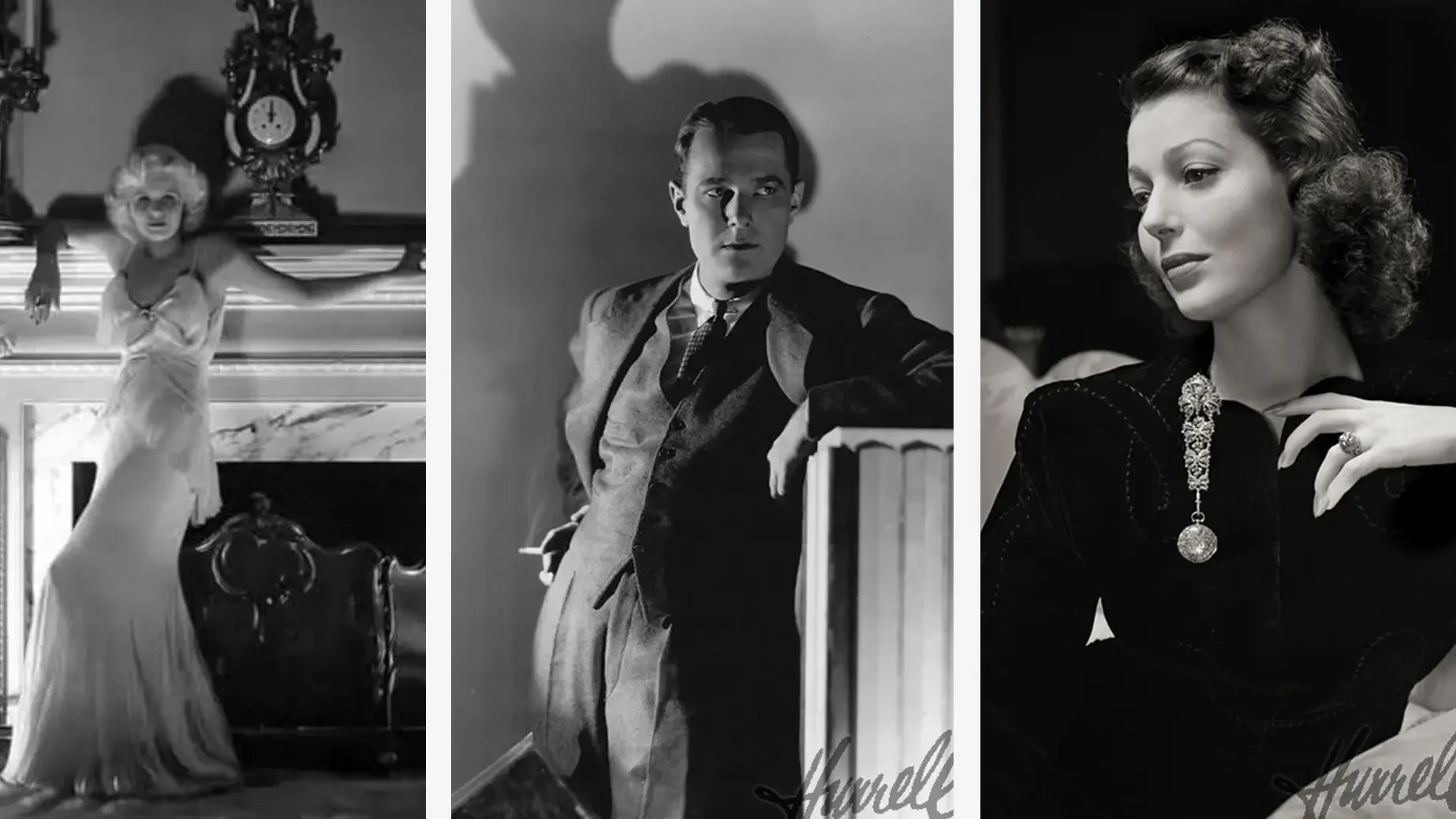
Hurrell joined MGM in 1930 and soon became the studio’s principal portrait photographer. Through the decade, his gelatin silver prints made the studio’s stars look larger than life and set the era’s standard for glamour. The lighting, the posing, and the distribution all served MGM’s investment in its contract players. This is the version of celebrity photography most people know. The star appears fully formed, and the institution behind the image stays out of the frame.
Norma Shearer Went Outside MGM
to Reposition Her Career
The portraits that brought Hurrell to MGM tell a different story. In 1929, Norma Shearer was one of MGM’s leading stars and the wife of Irving Thalberg, the studio’s head of production. Thalberg was preparing The Divorcee, and he did not see his wife in the lead. Shearer’s screen image was wholesome. The role called for a woman the studio did not believe she could play.
She did not wait for the studio to change its mind. Mark A. Vieira, Hurrell’s biographer and archivist, recounts how Shearer turned to Hurrell to change the way the studio saw her. Hurrell was then an independent photographer working from a Los Angeles studio. Late in 1929, Shearer hired him to photographer her. The series of portraits broke with her established screen image. Thalberg saw the prints and gave her the part. She won the Academy Award for Best Actress for the role. Within months, Hurrell was on contract at MGM.
Shearer was already a star, and MGM had its own portrait gallery. She went outside it because the institution’s version of her image was the problem. She treated photography as a positioning tool for her career, and she took control of it instead of waiting for the studio’s approval. The public saw the result, a new kind of Norma Shearer on screen. It rarely sees the private session that made the case for her.
Models Do The Same Thing
Working models also get type cast and need to find ways to move their careers forward. A model who pays for a photo shoot to update a book is commissioning images to change how agencies and clients see her, before any institution invests in her. Just like Shearer, they often take control of their narrative, their personal brand, by hiring a photographer on their own.
Personal Branding Joins the Carte’s Scale to the Star’s Production
Side by side, the history runs along two lines. The carte de visite gave individuals the celebrity’s seat at scale and sold them a standard product. Nadar, Steichen, Karsh, and Hurrell made fully produced, deliberate portraits for the famous, usually paid for by a publisher, an agency, a government, or a studio. Shearer stands where the lines cross: an individual arranging full production to reposition her career, ahead of the institution.
Personal branding photography is that crossing at scale. The consultant, the author, the coach, and the ambitious executive now commission the kind of production that magazines and studios once paid for on behalf of the famous. The “personal branding” term is recent. The techniques are not. They come from editorial, advertising, and studio portraiture. The demand has precedents running back to the 1850s.
The history runs in several threads that converge, separate, and converge again. A personal branding client brings a photographer the same goal Shearer brought to Hurrell: to change what the market sees before the market decides.
Where This Comes From
History of Photography, Module 03: Art vs. Commerce and the Rise of High Art Photography (the carte de visite, Disdéri, Nadar, and the stratification of the portrait market)
History of Photography: A Complete Course Outline (all thirteen modules)
Further Reading
National Gallery of Canada, Collecting Cards: Cartes-de-visite
Brown University Library, Anne S. K. Brown Military Collection, Cartes-de-visite
Swiss Camera Museum, The visitor’s card
Malcolm Daniel, The Metropolitan Museum of Art, Heilbrunn Timeline of Art History, Nadar (1820–1910) (2004)
Art Institute of Chicago, Edward Steichen online catalogue, Condé Nast, 1923–1937
National Portrait Gallery, London, Winston Churchill by Yousuf Karsh
National Gallery of Canada Magazine, Yousuf Karsh: Finding the Common Humanity behind Famous Faces
Art Canada Institute, Ottawa Art and Artists, Yousuf Karsh
Smithsonian Institution, National Portrait Gallery Presents Star Power: Photographs From Hollywood’s Golden Age by George Hurrell (2024)
Mark A. Vieira, George Hurrell’s Hollywood: Glamour Portraits 1925–1992 (Running Press, 2013), as covered in The Hollywood Reporter, George Hurrell’s Vintage Glamour Portraits of Hollywood’s Biggest Stars
Sourcing notes: The Shearer account relies on Vieira’s research as Hurrell’s biographer and archivist. The sources describe Shearer arranging the session; none documents who paid for it, and this article makes no claim on that point. The figure of 20 francs for twelve portraits is widely reported and traced to McCauley’s study of Disdéri; it has not been checked here against a primary record.