Standard Oil Hired a Documentary Photographer to Repair Its Name
The planning methods behind personal branding photography were formalized by corporations and magazines between the 1920s and the 1950s. What changed is that individuals can now hire what only institutions could afford.
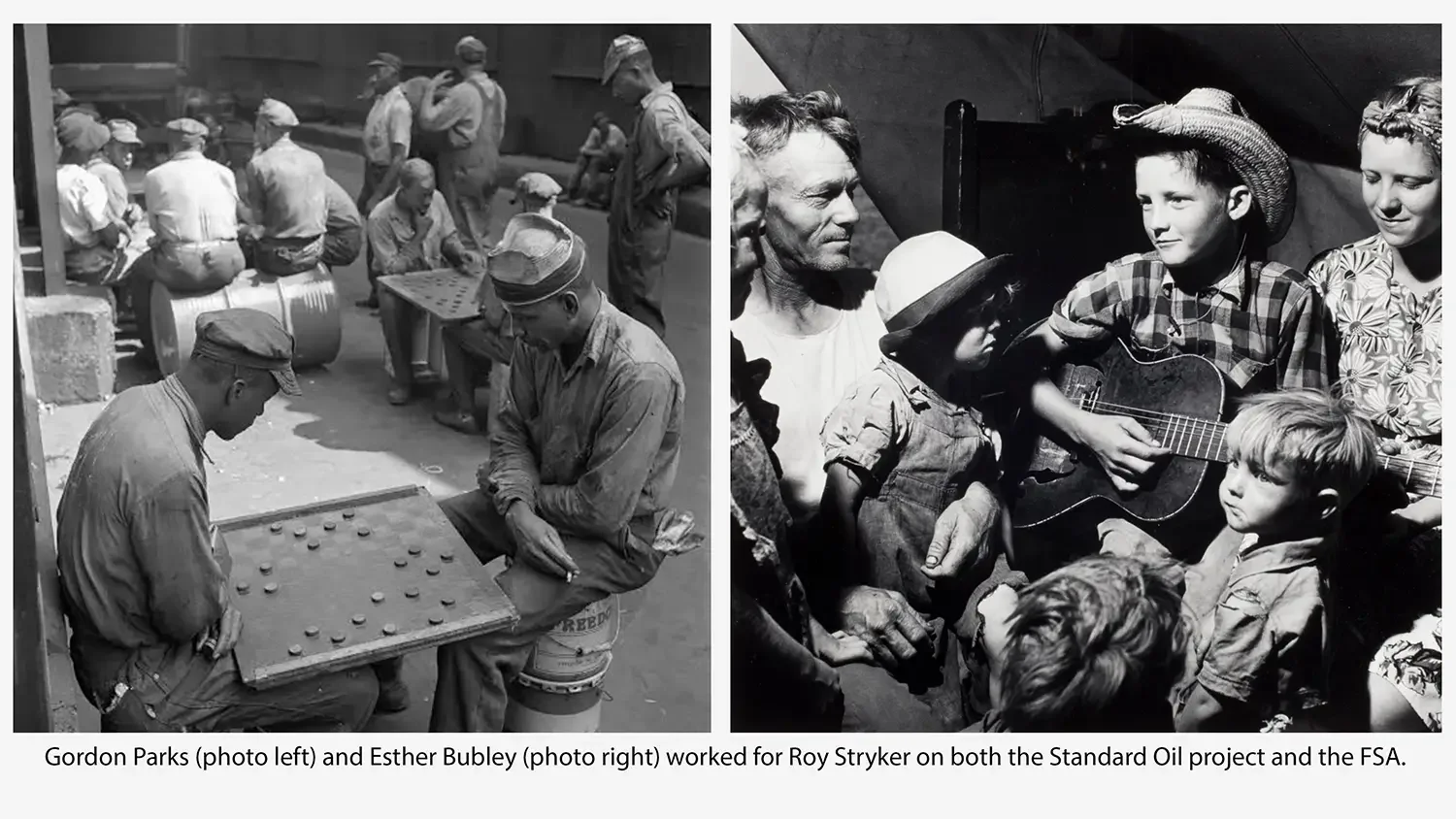
In 1943, Standard Oil was one of the most disliked companies in America. A Senate investigation the year before had raised accusations that its wartime business deals with a German chemical firm had slowed American synthetic rubber production. The company denied it, but the damage to its reputation was real. So Standard Oil hired a public relations counsel, commissioned opinion polls, and then did something that looked nothing like a corporate announcement: it hired Roy Stryker to run a photography unit and make pictures of ordinary American life.
Stryker Brought GovernmentRelationships
to a Corporate Client
Stryker knew how to run a photography project. At the Farm Security Administration during the Depression, he had supervised roughly twenty photographers documenting rural poverty across the country. He wrote what he called shooting scripts: not shot lists, but research briefs, written guides to the geography, the economy, and the social conditions of a place, so a photographer arriving in a small Texas town knew what to look for before they lifted a camera. The pictures that came back from those assignments are now considered landmarks of American documentary photography.
He brought the same method to Standard Oil. Before each assignment, he briefed his photographers and had them study the places they were going. One small Texas oil town was photographed five hundred times. The Gloucester fishing fleet. Lumber operations in the Northwest. By 1948 the company's files held 55,000 photographs, and in 1947 alone, 612 of them ran in magazines, newspapers, textbooks, and encyclopedias. The company made them available to any publication that asked.
The company set one firm rule: no photographs of unsafe work. No missing safety helmets, no absent safety belts. Some pictures still made executives uncomfortable. John Vachon photographed poor families in Venezuela. Edwin Rosskam photographed oil workers drinking beer in a Montana bar. Stryker had agreed to take the job only after Standard Oil promised him a free editorial hand, and he used it to defend both.
Bourke-White Was Hired
to Sell Stockholders
Fifteen years earlier, a steel company in Cleveland had done something similar for a smaller audience. Otis Steel needed to reassure its stockholders, and it hired a young photographer named Margaret Bourke-White to do it.
Bourke-White had opened a commercial photography studio in Cleveland in 1927, working on industrial subjects. Getting inside the Otis mill was a technical problem: molten steel glows intensely while the rest of a mill sits in deep shadow, and her first attempts couldn't hold both at once. She came back with magnesium flash. The results were strong enough that Otis published them as a bound album of ten prints for its stockholders in 1929.
The photographs showed a large, powerful, well-run operation. That was the point. The audience was small and specific, the purpose was trust, and the photography was planned to serve both. Henry Luce saw the pictures while he was planning a new business magazine. He made Bourke-White Fortune's first staff photographer that same year. Nineteen years later, Fortune ran its report on Standard Oil's photography project.
The Art Directors Club
Made Branding a Profession
The planning behind both projects wasn't improvised. By the 1920s, deciding what a photograph needed to accomplish before anyone picked up a camera had become a formal profession.
In 1920, advertising professionals in New York founded the Art Directors Club. An art director's job was to define the purpose of an image before it was made: the audience, the message, the composition requirements, the space it needed to leave for type. The club's first president, Heyworth Campbell, was the art director of Vogue. Clarence H. White, one of the most influential photography teachers of the era, worked alongside these early art directors. In 1922, Margaret Bourke-White took her first photography course from him.
By 1923, Edward Steichen was chief photographer for both Vogue and Vanity Fair under Condé Nast, and had signed a separate contract with J. Walter Thompson, one of the largest advertising agencies in the country. He photographed celebrities for the magazines and products for the ads, adjusting his approach to fit each assignment and each audience. A single photographer, working across editorial and commercial contexts simultaneously, treating each as a production problem with its own requirements.
Alexey Brodovitch took that production logic into magazine design itself. As art director of Harper's Bazaar from 1934 to 1958, he treated photography and typography as a single system. Images weren't placed on pages; they were designed with them. Irving Penn worked in his art department in the summers of 1937 and 1938. Richard Avedon began photographing for the magazine in 1945.
Individuals Now Commission
Branding Like Corporations
What Standard Oil, Otis Steel, Vogue, and Harper's Bazaar had in common was that they could afford to plan. They hired counsel, ran polls, wrote briefs, employed art directors, and briefed photographers before a single frame was exposed. The photography served a defined purpose because someone with institutional resources had defined it first.
That structure is what personal branding photography sells to individuals.
The methods are not new. The shooting brief, the art direction, the coordinated image set, the composition that leaves room for a headline: commercial photographers have been doing this work for institutions for a century. When I explain personal branding photography to commercial photographers I know, the usual reaction is recognition, not surprise. Once the work is described, the response is that it sounds like commercial photography. Different groups developed different names for the same structure.
What shifted is who is buying it. The individual professional now commissions the kind of photography that previously required a corporate budget and an in-house art director. Standard Oil needed 55,000 photographs and a Senate investigation to get there. A consultant in 2026 needs a morning and a photographer who knows how to run a production.
Where to Find More
History of Photography, Module 08: Modernism, Dada, Surrealism, and the Birth of Fashion Photography. How advertising and fashion absorbed avant-garde technique between the wars.
History of Photography, Module 09: Documentary Photography, the FSA, and World War II. Stryker's shooting scripts at the FSA, Walker Evans's line between truth-telling and persuasion, and the construction of documentary-style images.
History of Photography, Course Outline. All thirteen modules.
Further Reading
Fortune Editors, "A Portrait of Oil, Unretouched," Fortune, September 1948. Sourcing note: written while the project was running, by a publication that had hired Bourke-White and wrote for a business leadership audience. The account of why the project started comes from company officials.
The Michigan Daily, April 1, 1942, front page, digitized by the Bentley Historical Library, University of Michigan. Contemporary report of the Senate committee testimony, recording both the accusations and Standard Oil's denial.
University of Louisville Archives and Special Collections, "Standard Oil (New Jersey) Collection." Collection description, including the shooting scripts.
University of Louisville News, "Archives and Special Collections launches two new digital collections," October 3, 2024.
Harvard Business School Baker Library, "Breaking Down the Barriers." History of the Art Directors Club, Heyworth Campbell, and Clarence H. White's work with art directors.
The Metropolitan Museum of Art, "Ludlum Steel Company," Margaret Bourke-White, 1929. Collection entry noting her first photography course with Clarence H. White.
Amon Carter Museum of American Art, "Four Thousand Fahrenheit, Otis Steel Co.," Margaret Bourke-White, ca. 1927 to 1928. Sourcing note: the Amon Carter calls the stockholders' book The Story of Steel and dates it 1929; the Met dates it 1928. This article uses neither title.
Nelson-Atkins Museum of Art, "The Otis Steel Company," Margaret Bourke-White, 1929. Collection entry for the album of ten prints.
Herbert F. Johnson Museum of Art, Cornell University, "Cleveland Harbor," Margaret Bourke-White, 1929. Collection entry covering her move to Fortune.
Art Institute of Chicago, "Edward Steichen: Condé Nast, 1923 to 1937." Steichen's Vogue and Vanity Fair appointment and his J. Walter Thompson contract.
Barnes Foundation, "Alexey Brodovitch: Astonish Me," exhibition press release. Brodovitch's tenure at Harper's Bazaar.
Art Institute of Chicago, Irving Penn Archives, "Overview: Alexey Brodovitch and Irving Penn." Penn's summers in the Bazaar art department.