Craft Master Never Claimed It Was Teaching You to Paint
Palmer Paint moved twelve million kits on the promise of a finished picture, and was honest that a finished picture was all it sold. The preset industry sells the same thing and calls it education.
In 1951 the Palmer Paint Company of Detroit began selling paint by number kits under the Craft Master label. By 1954 it had sold roughly twelve million of them. The box tops carried the line “Every man a Rembrandt!” Critics were appalled. Number painting was called a symbol of mindless conformity, evidence that Americans wanted the appearance of culture without the labor that produces it. Every part of that objection is being made again right now about presets, in nearly the same words, by people who have never heard of Craft Master. What almost nobody making the argument knows is that the man who designed those kits agreed with the critics on the only point that actually matters, and said so in public for the rest of his life.
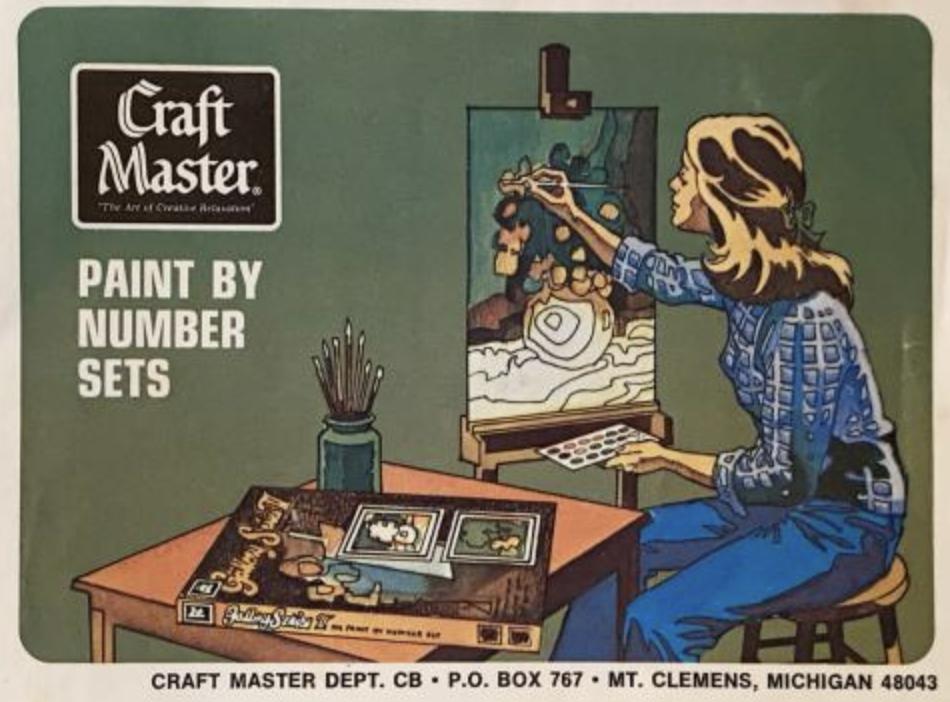
Twelve million kits and the same objection
Max Klein owned Palmer Paint and wanted a product that would move more paint. Dan Robbins was a commercial artist on his staff. The idea Robbins brought back was a canvas board printed with numbered regions and a set of numbered pots to match. Klein rejected the first version, which was a Cubist still life, and asked for something people would actually hang. Robbins gave him landscapes, seascapes, kittens, horses, and eventually The Last Supper, which became the best selling kit of all.
The scale is worth sitting with. Twelve million kits in three years, in a country of about 160 million people. Paint by number canvases hung in the Eisenhower White House. The cultural response was immediate and hostile, and it ran along exactly the lines you would predict. This was not art. It was assembly work wearing the costume of art. It flattered people into believing they had done something they had not done.
The defense was also familiar. It gets people painting. It puts a brush in the hand of someone who would never otherwise pick one up. If the alternative is a blank wall and no attempt at all, the kit is a net good. That is a real argument and I am not going to pretend it is a stupid one, because it is the same argument made for presets today and it has the same partial merit.
So the debate is seventy five years old, both sides have been rehearsed, and we have the advantage of knowing how it came out. What we should do with that advantage is notice where the modern version of the argument has quietly moved the goalposts.
I make my own presets
Before this goes further, my position needs stating plainly, because the argument against buying presets gets mistaken for an argument against having them and the two have nothing to do with each other.
I have a folder of develop presets on my drive. I made every one of them. They are saved decisions from jobs where I understood the light, kept because I expected that light again. Saved settings are ordinary craft practice and always have been. Printers keep notes on ink and paper and pressure. Painters keep records of what went into a mixed color. I came up through painting and traditional printmaking and in both of those rooms the notebook is a normal object that nobody apologizes for.
So the objection is not to the file. A preset is a few kilobytes of numbers and it is morally inert. The objection is to what the seller says the file is, and Dan Robbins is the reason that distinction can be drawn cleanly, because he drew it himself and he drew it against his own commercial interest.
Dan Robbins never once claimed it was art
In a book he published in 1998, looking back at the whole phenomenon, Robbins wrote: “I never claim that painting by number is art.” He went on to say that what the kit delivered was the experience of art, brought to someone who would otherwise never have picked up a brush or dipped it in paint, and that this was the entire extent of what it did.
Read that carefully, because it is doing something unusual. It is a modest claim, it is an accurate claim, and it is a claim that a man could have inflated at any moment to sell more product and declined to inflate for fifty years.
Now notice everything he did not say. He did not say the kit taught you to paint. He did not say you would come away understanding color, or value, or edges, or why one passage in a picture carries weight and another does not. He did not say you would be able to make the next painting without a kit. He sold a finished picture and the pleasure of producing one, and he described his product as exactly that.
The Smithsonian's National Museum of American History mounted an exhibition on the phenomenon in 2001, treating it less as art history than as a way into the history of creativity, leisure, and domesticity in postwar America. William Bird, the curator, has said he does not consider the finished canvases art either, while allowing that working one could show a person something about what art is. That is a careful position and it matches Robbins exactly. The kit was an experience, not an education, and the people closest to it were the ones most insistent on the difference.
Set that beside the copy on a preset sales page. Learn my workflow. Master your editing. My complete process. Those are not descriptions of a file. They are claims about what will happen to the buyer, and they are the claims Robbins spent his career refusing to make about a product that was, functionally, the same product.
You press the button, we do the rest, 1888
The one click promise is older than either of them. The Kodak camera arrived in 1888 with a slogan that was also an argument: you press the button, we do the rest. The argument was that photography no longer required knowledge, or skill, or even a decision about processing. The chemistry, the relationship between exposure and development, the judgment calls in the darkroom, all of it could be handed to someone else. I go through that rupture and what came out of it in the module on Pictorialism and the mass media divide.
George Eastman priced the camera at twenty five dollars, preloaded it with a hundred exposures, and built the business on a service rather than a device. You shot the roll, mailed the entire camera to Rochester, and it came back reloaded with your prints. Eastman was not describing a feeling when he said we do the rest. He was describing a shipping address.
That is the part people forget, and it is the part that matters here. The slogan is honest. It names both parties and it divides the labor out loud. You do this much. We do that much. A customer in 1888 knew precisely what they had contributed to the photograph in their hand, which is why the photographers who wanted the rest for themselves knew exactly what they were reclaiming when they went and got it.
A preset before and after names nobody. There is a file, there is a transformation, and the grammar of the presentation puts the buyer in the position of the one who did it. Kodak sold you a service and told you it was a service. That is a lower bar than it sounds, and most of this industry does not clear it.
What Warhol saw in the paint by number kit
In 1962 Andy Warhol made five paintings based on paint by number kits and called them Do It Yourself. They were shown at Stable Gallery in New York. Large areas of each canvas are left deliberately unpainted, with the printed numbers still visible, so you cannot look at one without seeing the instructions underneath.
MoMA's curator Ann Temkin puts the provocation as a question, and it is the right question. If anybody can make a painting by following the numbers and the instructions, then what is it that a real artist does that is different? Warhol was not sneering when he asked it. He treated the kit as a serious object, worth a year of his attention, because he understood that it was really a question about who is permitted to make pictures and on whose terms. I cover this period in the module on postwar art from Paris to New York.
He also answered the question, though the answer lives in the paintings rather than in anything he said about them. It is not that a real artist refuses instructions. Warhol used the kit. The answer has to do with knowing what the instructions are for, which is a different piece of writing and not this one.
What belongs here is the shape of the question itself. The kit was culturally destabilizing because it forced people to say out loud what they thought separated a painter from a person holding a brush. Presets have not forced that conversation, and the reason they have not is that the sellers have supplied an answer in advance. The answer they supply is that nothing separates them, and that you have already crossed over, and that the file in your cart is the crossing.
Nobody thinks a preset taught them anything
Here is the strongest objection to everything above, and it deserves a straight answer rather than a dodge. Nobody buying a preset actually believes they have been educated. They know they are buying a shortcut. Treating them as dupes is both condescending and wrong.
That is partly true. It is not true enough to save the argument on the other side, for two reasons.
The first is that the claim gets made regardless of whether the buyer fully swallows it. Marketing does not need belief, it needs permission, and the word education is what converts a forty dollar text file into something a working photographer can justify as an investment in the craft. Take that word out of the sales copy and the price does not survive contact with what is actually in the box.
The second reason is the one that settles it. Watch what the buyer does next. If a preset pack delivered what its page promised, there would be no second purchase, because the capability would now live in the photographer rather than in the file. Instead the pack that disappointed gets replaced by another pack, and then another, and the folder fills up with other people's numbers. That is not the behavior of someone who was sold a shortcut and understood it as one. It is the behavior of someone who was promised a capability and received a file, and who reasonably concluded that the problem was the file.
A person who had actually learned would stop buying. That is what learning does, and it is why teaching and recurring revenue pull in opposite directions.
The word doing all the work here is education
Robbins sold a result and said it was a result. Eastman sold a service and named the service. Neither of them was running a charity and neither was shy about revenue. Palmer Paint existed to move paint and Kodak existed to move film. Honesty about the transaction turned out to be entirely compatible with making a great deal of money.
The preset seller sells a result and calls it education, and that word is not decoration. It is load bearing. It is what sets the price, it is what distinguishes the product from a filter, and it is the one thing in the description that does not arrive when the file downloads.
I want to be precise about the charge, because precision is what makes it stick. I am not saying anyone is breaking a law. Establishing that would require proving things about intent that I cannot prove and do not need. The claim is narrower and harder to shake off: it is dishonest. The seller knows what is in the file, knows what a buyer would have to already understand for the file to be useful, and describes the product in terms that a buyer in that position cannot evaluate.
Palmer Paint moved twelve million kits without telling a single customer they had become a painter. That is not a high standard. It was cleared in 1951, by a paint company, in Detroit, with a straight face.
Where This Comes From
Further Reading
Dan Robbins, Whatever Happened to Paint-By-Numbers? (1998). Source of the quotation in this piece.
Smithsonian Magazine, on Dan Robbins and the origins of the paint by number craze
Smithsonian National Museum of American History, Paint by Number: Accounting for Taste in the 1950s (exhibition, 2001). The Palmer Paint Company archives were donated to the museum after Max Klein's death.
The Museum of Modern Art, Andy Warhol, Do It Yourself (Landscape), 1962
Sourcing note on the Robbins quotation. The line is from his 1998 book and reaches me through press coverage quoting it rather than through the book directly. I have not held a copy. If that matters to you, treat the wording as reported rather than verified, though it is quoted consistently across independent outlets.
Sourcing note on the sales figures. Twelve million kits by 1954 is the Smithsonian's figure for Craft Master specifically. Other accounts give higher numbers, some counting the whole industry after roughly thirty five competitors entered the market, and some counting a different span of years. I have used the museum's narrower figure throughout because it is the one tied to a single company and a stated date.
Sourcing note on the Leonardo story. Robbins said his idea came from a recollection that Leonardo assigned numbered patterns to his apprentices. He described it as something he remembered hearing, and I have seen no independent confirmation that Leonardo did any such thing. It is repeated widely as fact. It should not be.
Sourcing note on research method. Several sources here were located with AI assistance and then checked against the institutions holding the material. Readers are encouraged to verify independently. Statements about my own workflow and my own training are first person observations rather than sourced claims.