David Hockney Spent Decades Studying Photography's History.
This Month’s Obituaries Are Treating Him Like He Just Found the Camera.
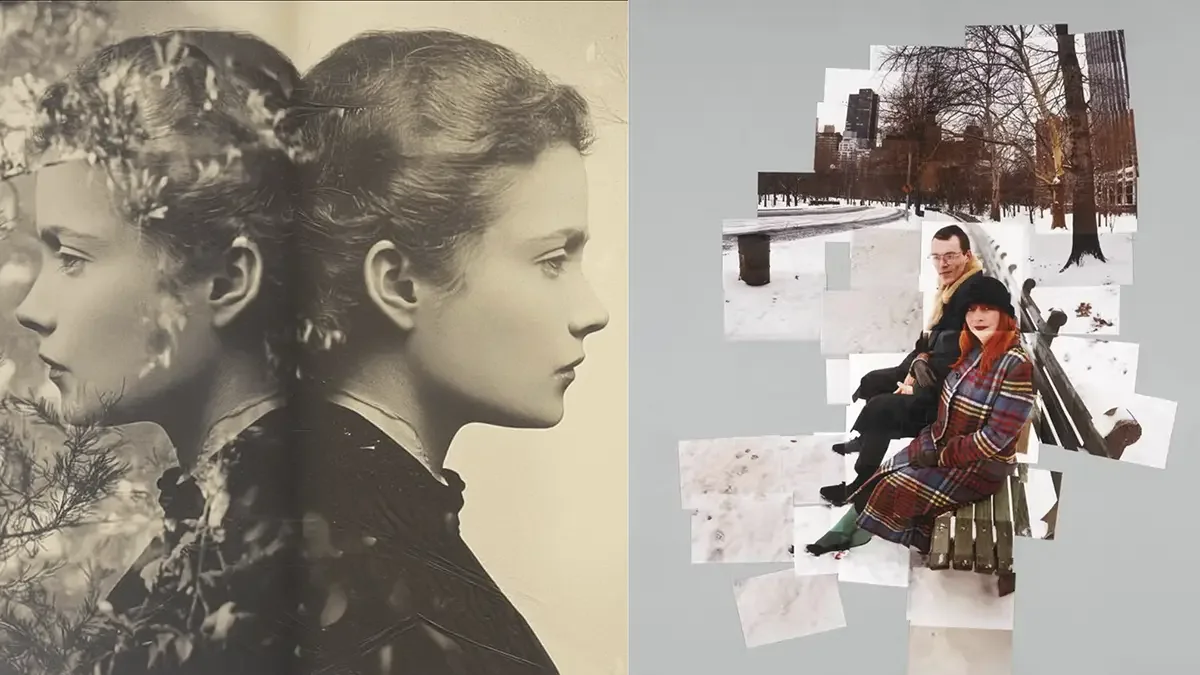
(left) Oscar Rejlander (right) David-Hockney
June 2026
Three pieces have crossed my feed this month marking David Hockney's death, and despite very different registers — a personal essay, an art-market content piece, a museum interpretation blog — they're telling the same story. A painter wanders into photography. He discovers it's broken. He fixes it with an idea borrowed from Cubism. In doing so, he says something about the camera no one had said before.
It's a good story. It also gets the one thing it should have gotten right exactly backwards: how much Hockney actually knew, and how little credit he's getting for knowing it.
None of what follows is an argument against Hockney's painting career, which doesn't need defending from me or anyone else, or against the joiners as a body of work. It's an argument against the framing currently being applied to both — outsider stumbles into a medium, finds a flaw no one had noticed, fixes it with borrowed tools. That framing makes Hockney smaller than he was. He wasn't an innocent. He was one of the more historically literate artists of his generation, working knowingly inside debates that were already a century old by the time he picked up a Polaroid.
The Joiners Weren't a First Draft. They Were at Least a Third.
Start with the claim doing the most work in this week's coverage: that the joiners were something genuinely new. MyArtBroker's retrospective calls Hockney's transition into photography a groundbreaking exploration that blurred the lines between two art forms, and treats the Pompidou's 1982 reception of his work as confirmation that he'd done something unprecedented.
Oscar Rejlander was already doing a version of this in 1857. He built composite prints by combining dozens of negatives into a single image, not as a stylistic flourish but because one exposure couldn't carry what he needed it to carry — a working method covered in my History of Photography module on the rise of High Art photography, where Rejlander sits alongside Henry Peach Robinson as the photographers who decided the single frame was a limitation to be solved, not a rule to be obeyed. Sixty years after that, Dada and Soviet photomontagists were fracturing the photographic frame on purpose, building meaning out of the seams rather than hiding them. By the time Hockney started gluing Polaroids together in the late 1960s, the idea that a photograph could be assembled from more than one exposure was already well over a century old.
And here's what actually stops me: the evidence that Hockney knew this is sitting inside the very review MyArtBroker cites as proof of his originality. The 1982 New York Times piece on his Pompidou show was a rave, and it's quoted approvingly this week as validation. That same review names his contemporaries — Joyce Neimanas, Robert Heinecken — who were doing recognizably similar work at the same time. The detail that complicates the "no one had done this before" story isn't buried in some obscure archive. It's in the source material everyone's citing approvingly right now. Nobody has seemed to have read all of it.
Cubism Didn't Rescue Photography. Photography Lent Cubism Half Its Vocabulary First.
The second claim running through this week's tributes is about lineage, and it runs in the wrong direction. The story has photography trapped in a single fixed viewpoint until Cubism showed it the way out, with Hockney as the messenger carrying the lesson home. The National Science and Media Museum's piece on the Bradford joiner gets closer to the truth than the others — it actually shows you the mechanics, the woman in the beige jacket walking past the camera frame by frame, the two different photo shops, the two days of weather bleeding into one image — but even that piece accepts the premise that Cubism is where the multi-perspective idea originated.
It didn't. Eadweard Muybridge lined a racetrack with a dozen cameras in 1878 to settle a bet about whether a galloping horse ever has all four hooves off the ground at once. It does. What the sequence also proved, almost as a side effect, was that the camera could break a single continuous action into discrete, reassemblable positions — that a fixed viewpoint was a choice, not a law of vision. Étienne-Jules Marey pushed the idea further with chronophotography, stacking an entire sequence of movement onto one plate. I cover this stretch of the timeline in Module 07 of my History of Photography course, and the throughline is direct: this is the period where photography handed painting part of the visual grammar it would later get credit for inventing. Picasso and Braque started painting in a culture that had already absorbed the idea that a single fixed viewpoint was optional, three decades after Muybridge's racetrack.
A man who spent as much of his career thinking about Picasso as Hockney did was not the artist likely to get that sequence backwards by accident. The joiners read differently once you assume he saw the full loop — photography to painting and back to photography — rather than assuming he was simply handed a fix from outside his own medium.
He Wasn't Discovering That A Camera Isn’t Neutral. He Was Citing It.
The most quoted line from Hockney this week comes from Grant Scott's tribute on The United Nations of Photography, where Hockney is recalled saying there can be “no such thing as a neutral observer.” It's a good line, Hockney earned the right to say it, and Scott's piece treats it — gently, but unmistakably — as something close to a personal discovery, the hard-won insight of a man who'd spent a lifetime moving between drawing, painting, and the camera.
It isn't a discovery. It's a citation of an argument photography had already been having with itself for a hundred years before Hockney was born. Jean-Martin Charcot staged weekly exhibitions of hysteria patients at the Salpêtrière hospital in the 1870s, coaching their expressions before an audience of scientists and socialites, then published the photographs as clinical documentation — all while insisting his camera was a neutral instrument. Duchenne de Boulogne wired electrodes to a man's facial muscles to manufacture expressions of terror and grief, then photographed the results as systematic science. I walk through both cases in Module 05, on photography and the myth of objectivity, and the pattern across that module is consistent: every nineteenth-century field that trusted the camera as a neutral recorder — medicine, anthropology, law, ethnography — eventually had to confront the same failure. The camera did not lie. It selected. And the selecting was always a decision made by the person behind it, not a flaw in the instrument.
Hockney wasn't finding something new about photography. He was restating something photography had already proven about itself, repeatedly, in public, and saying it with more style than most of the people who'd said it before him.
What Hockney Actually Knew
Here's where I want to be precise, because it's easy for an argument like this to slide into "the artist didn't know what he was doing," and that's not my point at all. The opposite is true, and there's real evidence for it.
Hockney wrote Secret Knowledge, a decades-long, book-length investigation into how Old Master painters used optical devices — camera obscuras, concave mirrors, lenses — centuries before photography existed to take credit for the idea. That is not a book written by someone naive about the history of mechanically assisted image-making. It's the opposite: a painter who went looking for the seams in his own discipline's history and published what he found, regardless of how controversial it was. He developed the joiners in direct conversation with Alain Sayag, the Pompidou curator who challenged him to mount the 1982 show in the first place — and Sayag's entire job, as a photography curator at one of the world's major museums, was knowing the Rejlander-to-Heinecken lineage cold. Hockney wasn't working in isolation from that history. He was working inside a room with someone whose career was built on knowing it.
None of this makes the joiners less interesting. It makes them more interesting, and it changes what they're actually doing. They're not the work of an artist who innocently bumped into photography's limitations and patched them with an idea from painting. They're the work of an unusually well-read practitioner who understood precisely what he was building on, chose to build there anyway, and made something specific and personal out of inherited tools — his own eye, his own argument about what looking actually feels like, layered on top of a tradition he almost certainly recognized. That's a higher compliment than "he invented this." It's also a more interesting sentence to write, which may be exactly why none of this week's coverage wrote it.
Why the Writers Got This Wrong
I don't think any of the three writers here were being dishonest. I think they were doing what obituary writing under deadline pressure does to nuance, which is flatten it. “He discovered something no one had seen” is a better headline than “he was a historically literate practitioner working knowingly inside a hundred-year-old debate, and made something good out of it anyway”. One of those sentences is true. The other one travels. Hyperbole isn't a character flaw unique to any one of these pieces — it's close to a structural feature of how tribute writing gets made and shared, and all three pieces here are participating in a habit that's much bigger than David Hockney.
But the habit has a cost, and the cost is Hockney himself. Treating him as the artist who stumbled onto photography's flaws by instinct erases the part of the story that actually makes him worth writing about this week: that he was paying close enough attention to his own medium's history to write a book about painting's debt to optics, to work side by side with a curator who'd lived inside the photography canon for decades, and to make work that knowingly answered a debate he understood better than most of the people now eulogizing him.
The painting career stands on its own. The joiners stand on their own. Neither one needs the myth of an artist who didn't know what he was doing. He knew. That's the more interesting story, and it's the one that needs to be written.