The Photograph Belongs to Eve Arnold.
The Veto Belonged to Marilyn Monroe.
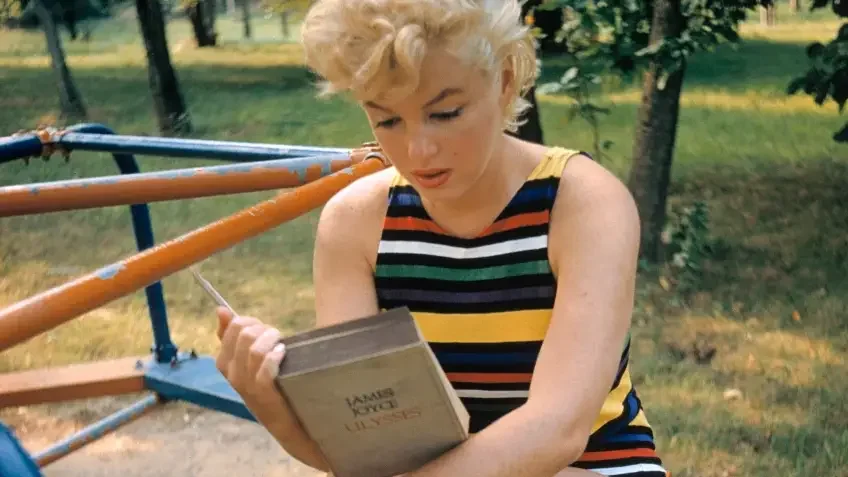
Marilyn Monroe Mount Sinai Long Island 1955 by Eve Arnold
The National Portrait Gallery's new Monroe exhibition is built on a generous reading of a 1955 photograph: Marilyn Monroe, on a beach on Long Island, absorbed in James Joyce's "Ulysses," nearly at the end, on the page where Molly Bloom's soliloquy runs. The gallery's argument, echoed by the critic Griselda Pollock, is that Monroe chose that moment deliberately as a knowing, literary middle finger to the dumb-blonde persona Hollywood had built around her.
I want to correct the record before that reading hardens into fact, because it gets the authorship backward. And I want to be precise about what I'm correcting, because there are two separate claims tangled together here, and only one of them is true.
What Authorship Actually Means
Eve Arnold made that photograph. Not Monroe.
Arnold chose to shoot away from a studio set, on a beach, without lighting or wardrobe; a deliberate departure from how Hollywood publicity photography normally worked in 1955. That choice wasn't incidental. Arnold built a six-decade career on the conviction that subjects revealed more of themselves outside the studio than inside it, whether she was photographing fashion shows in Harlem or Malcolm X addressing a crowd in Washington. Shooting Monroe on a playground in the middle of an ordinary afternoon was Arnold applying a working method she'd developed everywhere else.
Arnold decided to keep loading film while Monroe kept reading, rather than stopping her or asking her to set the book down. That's a photographer's judgment call about when not to intervene — itself a form of control, the kind documentary and portrait photographers exercise constantly and rarely get credit for.
Arnold selected which frames survived contact. This is the single most consequential decision in any photographer's process, and it's the one audiences never see, because by definition only the chosen frame exists for them to look at. Whatever Monroe's face, posture, or page-turning looked like in the eleven frames Arnold didn't keep is information that has simply vanished from the historical record. We are only ever evaluating Arnold's choice.
And Arnold made the choice that mattered most of all: she embargoed nearly all of her Monroe photographs after the actress's death in 1962, holding them back for a quarter century to protect the work from exploitation, and released this image on her own terms in 1987, in her book "Marilyn Monroe: An Appreciation." The timing of when the world got to see this photograph, and in what context, and next to which other images, was Arnold's decision. Not Monroe's. Not the gallery's, until six decades later.
Every structural decision that turned a woman reading on a beach into a photograph with a point of view belongs to the photographer. That's not a technicality. That is, definitionally, what authorship means — and it's worth saying plainly, because the gallery's framing doesn't deny any of this. It just doesn't mention it.
The Candid Fallacy
The deeper problem with the gallery's reading isn't just who gets credit. It's the unexamined assumption sitting underneath it: that because the photograph looks unguarded, it must be telling us something more honest about who Monroe really was.
Documentary photography has been litigating this exact question since the 1930s, and the verdict has never changed. In 1936, Arthur Rothstein moved a steer skull eleven feet across a South Dakota field to get a more dramatic Dust Bowl photograph for the Farm Security Administration, and the agency spent years managing the credibility damage. Roy Stryker, who ran the FSA's photography unit, insisted the whole operation was publicity rather than propaganda — a distinction that required considerable confidence to maintain, given that he was also selecting, captioning, sequencing, and distributing every image with a specific political goal in mind. Dorothea Lange's "Migrant Mother" became the defining image of the Depression not purely on the strength of the moment, but because the FSA repeatedly pushed it to newspapers, and because Lange herself had a retoucher airbrush out a detail she considered a flaw before it went out into the world.
The pattern holds straight through World War II. Robert Capa's D-Day frames are blurred because a darkroom assistant overheated the film while developing it — and the blur, a technical accident, became visual shorthand for urgency and read as more authentic, not less. Joe Rosenthal's Iwo Jima flag-raising is the second flag-raising, restaged because the first flag was too small to photograph well from the beach. Yevgeny Khaldei photographed a Soviet flag over the Reichstag a few months later using a flag his uncle had sewn from red tablecloths, and openly staged the shot. Every one of these images reads as spontaneous. None of that spontaneity is proof of anything except that someone behind the camera made it look that way.
By the 1980s, photographers had stopped pretending otherwise. The "directorial mode" — Sandy Skoglund, Laurie Simmons, and others building entire theatrical scenes specifically to be photographed — was a direct rejection of the "decisive moment" myth that had governed photojournalism for decades. Nobody confused the resulting images with the subject's agency. The photographer's authorship was simply assumed, because constructing the image was understood to be the photographer's job.
"Candid" is a style decision, not a truth serum. It has never been one — not in 1936, not in 1955, not now. The Arnold photograph reads as unguarded because Arnold made decisions that produce that reading. That's craft, and it's a particularly good example of it. It is not evidence about Monroe's interior life independent of Arnold's eye.
What the Feminist Framework Actually Protects
The gallery is implicitly borrowing from a feminist art framework that should have prevented this misreading rather than enabled it.
Cindy Sherman's "Untitled Film Stills" work as criticism specifically because Sherman occupies every position in the image simultaneously: she is the photographer, the subject, and the editor choosing which exposure survives. That triple role is what gives the work its argument about how women are represented in visual culture. It is also what's structurally absent from the Arnold photograph. Monroe held one of those three positions. Arnold held the other two.
Barbara Kruger built an entire career on a single, repeated claim: someone is always assigning meaning to images of women, and the assigning is rarely done by the woman in the frame. The 1977 "Pictures" exhibition — where Sherman first showed alongside Sherrie Levine — used staged self-portraiture and re-photographed mass-media images precisely to dismantle the myth of a single authorial genius standing innocently behind any photograph. These artists exist to protect photographers, especially women photographers, from exactly the kind of erasure happening here: crediting the sitter with decisions that belong to the person who held the camera. Using feminist art history to hand Eve Arnold's authorship to her subject doesn't extend the framework. It inverts the entire point of it.
There's a layer of irony worth sitting with. Arnold was the first woman admitted to Magnum Photos, working in a field that was overwhelmingly male, building a body of work specifically grounded in observing real environments rather than constructing studio fictions. An exhibition framed around recovering a woman's interior truth has, in the process, quietly erased the actual female gaze responsible for the photograph — Arnold's — and relocated it into the subject instead. If the goal is to correct the historical record on whose perspective shaped this image, the corrective points at the photographer, not away from her.
The Diane Arbus Problem
There's a related point worth making, because it cuts the same direction from a different angle. Diane Arbus didn't photograph her subjects as neutral sociological documents. She photographed people at the edges of social legibility and showed them as more fully inhabited than the people doing the categorizing — which says as much about Arbus's interpretive eye as it does about anyone in her frame. Nobody looks at an Arbus photograph and credits the subject with the psychological depth on display. We understand, correctly, that depth as something Arbus constructed through her choices about framing, distance, and moment.
The same logic applies here. Whatever "interiority" the Arnold photograph reveals is Arnold's interpretation, rendered through Monroe, the same way Arbus's interpretations were rendered through her subjects. That's not a knock on the photograph. It's a more accurate description of how the photograph works — and it's a description that, again, credits the photographer.
What Monroe Actually Controlled
None of this means Monroe had no agency. She had a real, sourced, well-documented form of it. It's just not the one the gallery is selling.
Monroe went through her own contact sheets and scratched out, with a hairpin, the prints she didn't want released. That's verifiable control over her own image, and it's rarer than people assume. FSA subjects in the 1930s — the families Walker Evans and Dorothea Lange photographed across the rural South and Dust Bowl states — had no comparable say over which frames Roy Stryker sent to Life magazine, or what ran underneath them as caption. They were subjects in the fullest sense: photographed, selected, and distributed by people who held all the power those words imply. Monroe held a veto. That's a meaningfully different, and stronger, position.
Monroe's leverage over her own image existed at the level of distribution and release — which prints got out, which didn't. It did not extend to authorship of the photograph itself, which is a different position entirely, and one she never occupied in this frame. Conflating the two doesn't strengthen the case for Monroe's intelligence or agency. It actually weakens it, by substituting an unfalsifiable claim about literary intent for a real, documented one about editorial control she demonstrably exercised.
Two Claims, Kept Separate
Eve Arnold authored the photograph: the frame, the restraint, the choice to shoot without artifice, the decision about when to intervene and when not to, the twenty-five-year embargo, the eventual publication on her own schedule and in her own book. That is the work of a photographer operating at the height of her craft, and it deserves to be named as such.
Marilyn Monroe exercised real control over her own image — through the contact sheets she was allowed to edit, through the veto power most photographic subjects in history never had access to. That's worth crediting too, on its own terms, without dressing it up as something it wasn't.
Collapse the two into one continuous story about Monroe's "agency" over a photograph she did not make, and the actual photographer disappears from her own picture. Given who Eve Arnold was, and what she spent her career proving about access, trust, and the discipline of staying out of the way until the moment is right, that's not a small erasure. It's exactly the one her own work was built to argue against.
Reference Links
Source article being responded to:
CNN, "Marilyn Monroe through the female gaze" (June 2026) — https://www.cnn.com/2026/06/03/style/marilyn-monroe-reading-ulysses-eve-arnold-snap
National Portrait Gallery, London — "Marilyn Monroe: A Portrait" exhibition page — https://www.npg.org.uk/whatson/exhibitions/2026/marilyn-monroe-a-portrait
Education content anchors:
History of Photography — Module 09: Documentary Photography, the FSA, and World War II — https://www.scottparkerphoto.com/history-of-photography/09-documentary-and-fsa
Modern Art — Module 06: Contemporary Art (gender, sexuality, and the gaze) — https://www.scottparkerphoto.com/modern-art/06-contemporary-art
Works and figures referenced:
Eve Arnold, "Marilyn Monroe" (current edition of An Appreciation, 1987), publisher page — https://www.simonandschuster.com/books/Marilyn-Monroe/Eve-Arnold/9781788842778
Griselda Pollock, 2016 essay on the Arnold/Monroe photograph, cited in Journal of Visual Culture — unverified. I could not locate a working link to the essay itself or confirm the citation independently of the CNN piece. Don't link this one without checking it yourself first.
Arthur Rothstein, Dust Bowl skull photograph (1936), Library of Congress record — https://www.loc.gov/item/2017760596/
Dorothea Lange, "Migrant Mother" (1936), Library of Congress research guide — https://guides.loc.gov/migrant-mother
Robert Capa, D-Day / Omaha Beach photographs (1944), Magnum Photos — https://www.magnumphotos.com/newsroom/conflict/robert-capa-d-day-omaha-beach/
Joe Rosenthal, "Raising the Flag on Iwo Jima" (1945), National Archives — https://www.archives.gov/research/still-pictures/highlights/flag-raising-on-iwo-jima
Yevgeny Khaldei, "Raising a Flag over the Reichstag" (1945), Wikipedia — https://en.wikipedia.org/wiki/Raising_a_Flag_over_the_Reichstag
Cindy Sherman, "Untitled Film Stills" (1977–1980), MoMA collection — https://www.moma.org/collection/works/56618
Barbara Kruger, "Your Gaze Hits the Side of My Face" (1981), Smarthistory — https://smarthistory.org/barbara-kruger-untitled-your-gaze-hits-side-face/
"Pictures" exhibition (1977), Artists Space archive page — https://artistsspace.org/exhibitions/pictures
Diane Arbus, Metropolitan Museum of Art overview — https://www.metmuseum.org/exhibitions/listings/2005/diane-arbus