Actor Headshots New York City

Booking a Role?
Casting is Looking for YOU.
They are not looking for your edit, affect, or costume.
You know your types. You’ve trained. You’ve auditioned, and you know what you bring to a project. Your headshot is how casting meets you for the first time. On every submission, it hits before your reel and your resume.
Casting scans hundreds of thumbnails for every role. A generic headshot gets passed over. When your headshot shows a type you can book, with your look and your own essence, casting can picture you in the role. They call you in, and the person who walks through the door is the same person they noticed.
Next NYC Sessions
November 18 (filled)
December 5
Let’s shoot for the roles you want.
Comein with one or two types you’re ready to book Commercial, Theatrical, or both. The set is ready for your arrival. The full hour belongs to you.
Bring the clothes you’d wear to an audition for those roles. Bring some alternates. You know how things go. Sometimes sticking to the script is best. Sometimes the improv is the better take. In the studio, you’ll see which ones support each type best.


We can show casting who you are
Casting knows how to imagine you in a part. Give them a clear starting point: you, in a type you can book. Your personality carries the image, and your wardrobe supports the type.
Costume is not the key. You are. It starts with you. You bring a type to life. Your wardrobe could support the role, but it is less important than you, your unique essence, and what you bring to the project.

Direction from start to finish
You get direction the whole time. A small amount of posing puts you in the right positoin in frame. Really, it’s closer to blocking than posing. The rest is directing. What you’re thinking, what you’re reacting to, so the actor in you comes through and the expression fits the type. Collaborative and steady. An hour gives you a little time to settle in and find the shot that can help you get called in.

All the photos from your session also go into a private review gallery for 30 days. You can purchase additional images from that gallery at your convenience within those 30 days.
$50 as they appear in the gallery (unretouched) instantly available for download upon purchase.
If you want them retouched, let me know afterward and I can send retouched versions for an additional $50.
You see the images as they are captured
Tethered to a laptop, the images can be reviewed, frame by frame during the session. You choose your images before you leave. Pick the best from theatrical or commerical, whichever you need most. Mix and match. You walk out knowing what was captured.
Two finished images, ready to submit
Retouched for casting: temporary blemishes, some stray hairs, uneven tones. The photo still looks like you, and that’s what casting is counting on. Your images are delivered within a week. They can be sized for Actors Access, Casting Newtwork, and Backstage. Simply let me know.
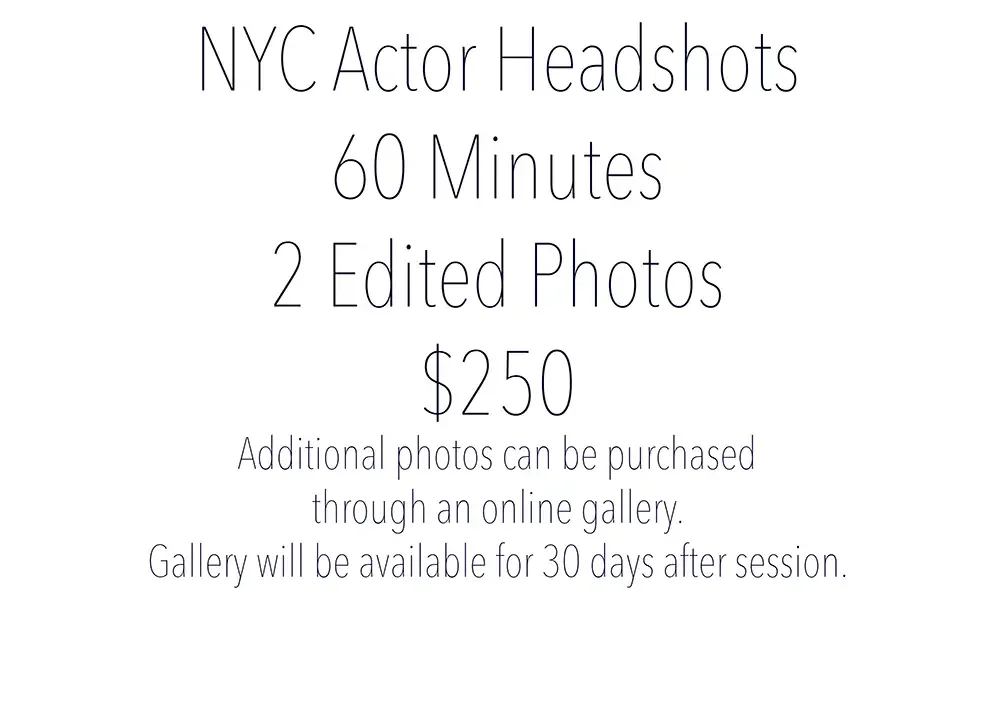
NYC Actor Headshots
60 Minutes
2 Edited Photos
$250
Additional photos can be purchased
through an online gallery.
(Gallery will be available for 30 days after session)
NYC Actor Headshots
Frequently Asked Questions
-
Commercial headshots are brighter and more open, the energy cast wants for commercials, print ads, and brand work.
Theatrical headshots carry more depth and weight, for film television, and stage.
Many actors experiment with the same type in both commercial and theatrical lighting to find interesting intersections. It comes down to the mood they want to create and the roles for which they want to apply
-
Yes. It’s certainly possible. Think of a couple of types, then choose commercial, theatrical (or both). Your finished images can be chosen from any mix. Choose whatever serves teh roles you are going for.
-
Your type is a role casting is filling, with your look and your essence. Start with your playable age (the range you can believably be cast). It’s usually less than 10 years. Then, look at the roles in shows that are casting now and ask whether your look and your essence could book each one. Ask people who know your work, professionally, what roles they see you in.
You’ll also hear the word “archetype”. An archetype is the broad pattern, like the caregiver or the rebel. Your type is the bookable version of it. The caregiver is an archetype. The mid-thirties nurse who holds together both her at-home family and her work family is a type.
-
Come in with your best guess. Use the steps in “How do I find my type? to land on one or two types that feel close, even loosely. Remember, we are often suprised by what types of people fit different roles. It’s good to think about type, but we don’t need to type-cast.
The session gives a little time to settle into them, and you’ll see as you review photos which one read best for you.
-
They can. Typecasting show up two ways. You’re working, but in roles you’re ready to move past. Or, you’re not booking because casting sees you as a type that doesn’t fit you anymore. Either way, a new headshot changes which type casting sees first. Come in with the type you want to be seen for next. Your headshot works alongside your training, your experience, your reel, and your representation, so it’s one part of the shift you are trying to make.
-
Update your headshot whenever the person who walks into the room has changed from the person in the photo.
A new haircut or color, a change in weight, or a few years of maturing into your face are all reasons to update. A current headshot lets casting picture you in the role and call you in with confidence.
-
Retouching covers temporary blemishes, some stray hairs, and uneven skin tone. Permanent features stay, because casting is calling in the face they see. Your unique physical characteristics are what make you stand out and can add to the character you play. They are assets.
A retouched photo looks like you, on a good skin day, ready to walk in the audition room.
-
Yes. Retouched images are delivered within a week, sized and ready to upload.
-
Arrive with your hair and makeup done and camera-ready. The full session time goes to photography.
If you work with a makeup artist or hair stylist, bring them along for touch-ups on set. The session ends on a schedule, so keep touch-ups quick so you get the full benefit of the session time in front of the camera.
-
The actor prep guide at the bottom of this page walks you through this process.
In short:
Get enough rest, drink enough water, and be ready to roll at the start of the session. -
Yes. Every frame goes into a private review gallery for 30 days.
You can purchase (and download) additional images directly from the gallery for $50, unretouched.j
After purchase, if you want any of the images retouched, reach out to me and retouched can be purchased for an additional $50 per photo.
-
Marketing is a layered effort, with many different assets needed. Headshots are an important tool in your marketing kit.
The focus during a headshot session is creating the couple of headshot photos that are going to be the first impression that casting sees.Many actors purchase alternate takes to feed their social media platforms as a way to stay top of mind.
You have your official headshot, the ones you are choosing at the end of your session. The official headshot is what you show to casting along side your resume.
The alternates exist to keep the industry at-large interested in you beyond your past projects.
Actor Prep Guide
Show up with your types
Bring one or two types you’re ready to book. If you’re still working them out, a best guess is enough to get going. Look above in the FAQ for “How do I find my type?” and “What if I’m not sure of my type?”
Wardrobe
Bring the clothes you would wear to an audition for your types, with a few alternates for each. Solid colors work best, subtle patterns are nice. Bold can work, but carefully consider if it is adding to the impression or taking attention from you. Are they casting a bright bold pattern or are they casting you?
Layers are a great way to add variety, texture and interest without distracting from the main character (you). Layers give us a chance to mix and match to find aesthetics that have the impact you want.
Hair and Makeup
Show up with your hair and makeup done. Your artist is welcome on set for quick touch-ups between frames; shine, a stray hair, a lip refresh. Tough-up time comes from your session time, so small fixes keep the most time for your headshots.
The Day Before
Get a good night’s rest and stay hydrated. It’s amazing how much better the photos are when you are rested, hydrated, and full of positive energy!
Timing
Arrive a few minutes early. Your session starts and ends on schedule so all the time goes to you.
Actors under 18
A parent or guardian must stay on set for the full session.
Have question before you book a shoot?
Fill out this form and ask.
I’m happy to get back to you as soon as I can.
I’ll follow up personally as soon as I can, usually within 48 hours.
Actor Headshot Glossary
(key terms)
Context
Type means role category.
Look means physical appearance.
Who The Actor Is
Essence (vibe, energy, what you bring to the room, personal quality): qualities an actor carries regardless of role. Warmth, edge, humor, stillness, intensity. It comes from the actor, not from wardrobe or lighting.
Personality (personal characteristics, who you are): the actor’s real temperment as it shows in theri face and manner. Essence is how casting reads it.
Playable Age (age range, playing range): the span of agens an actor can believably be cast at, usually narrowed to about 7-8 years. It can differe from the actor’s real age.
Look (physical appearance, physicality): what the actor visibly is. Build, coloring, features, hair. One of the three parts of type, along with playable age and essence.
Context changes the meaning.
From casting, “look” means appearance.
From an art director, stylist or fashion photographer, it usually means a styled setup or overall aesthetic (“the second look”, a “clean look”).
Acting coach (sometimes) use it to mean type.
When someone uses the word, it helps to know which they mean.
What Casting is Filling
Archetype (character archetype): a broad, universal character pattern, not tied to age or appearance. The starting point of a type.
Type (casting type, role category): an archetype made bookable, combining playable age, look, and essence for roles in current work. Actors usually have a few.
Range (versatility): the set of types an actor can believably book.
Typecast (typecasting): when casting keeps booking an actor in the same type, including ones the actor wants to move past.
Pigeonholded (mistyped, stuck): when casting sees an actor only as a type that isn’t booking. Often called typecasting by actors.
Character (role, part): a specific person in a specific script. Casting fills characters by first finding the right typye. A headshot points toward types, not characters.
Breakdown (casting brfeakdown, casting notice): the written description of a character casting is looking for, usually stated in type terms.
How the Market Splits
Commercial (commercial headshot): aimed at commercials, print, and brand work. Lighter and more open in expression. Usually the same types as theatrical, played with a brighter energy.
Theatrical (theatrical headshot, “legit”): aimed at film, TV, and stage. More depth and weight in expression. Usually the same types as commercial, played with more stillness or intensity. (“Legit” sometimes specifically mean stage).
What Surrounds the Actor
Wardrobe (clothing, tops, outfit): what the actor wears to support a type. Chosen for the role it signals, not for personal style or how it photographs alone.
Costume (dressing up, props): wardrobe or accessories that try to become the character. Casting can read it as the actor not trusting them (casting) to imagine.
Affect (putting it on, playing a version of yourself, mugging): performance that sits on top of the actor rather than coming from them. Reads as false.
What Happens in the Session
Direction (coaching, prompting): guidance that changes what the actor is thinking or feeling, which changes expression. Thoughts, intentions, a moment to react to.
Posting (positioning, physical adjustments): guidance on body and face mechanics. Chin, shoulders, eye line. Useful, but on its onw it can produce a model’s photo rather than an actor’s.
Expression (read, what’s behind the eyes): what the face communicates in the frame. The result of direction plus essence.
What Happens to the Photo
Headshot (primary image): the actor’s main photo for casting. Typically chest up, can be a tighter or looser crop (closer/further).
Thumbnail (submission image): the small version that casting sees first on the pages that contain all submissions as they scan hundreds of images quickly. A headshot has to read at this size to get noticed.
Submission (submitting): sending a headshot, resume, and rell to casting for a specific role, usually through platforms like Actors Access, Casting Networks, or Backstage.
Retouching (editing, cleanup): changes to the finished image. For actors, limited to daily imperfections, temporary things that can be fixed so the the photo still matches the person who walks in the door.