The Preset You Built
Is a Record of What You Understand
A preset you make and a preset you buy are the same kind of file.
The difference is whether you can read it, (and the people selling them are counting on your not being able to).
I have a folder of presets. I made all of them. Each one is a set of decisions I made once, on a job where I understood the light. I made, and saved presets, because I expected to face that light again. When one fails, I know why, because I know what is in it. I have also bought presets. Almost every one added more time to my work and none fully produced what I wanted. The file format is identical. A preset I built and a preset I bought are the same kind of object. What differs is whether I can read it and whether it does exactly what I want. Everything that is wrong with the preset economy lives in that gap.
The Same File,
Two Completely Different Objects
I am not against the making of presets. I want to be clear about that before anything else, because the argument against buying them gets mistaken for an argument against having them, and the two are not related. Saved settings are ordinary craft practice. Printers keep notes on ink and paper and pressure. Painters keep records of what went into a mixed color. I came up through painting and traditional printmaking, and in both of those rooms the notebook is a normal object. It’s simply good operating practice.
But a note in a printmaking notebook is not a set of instructions. It is a record. When I write down an ink formulation, I am writing down the conclusion of a process I lived through, and the numbers work as an index to that process. Hand the same note to a stranger and it does almost nothing, because the stranger has a different press, a different paper, a different hand on the wheel. The note was never addressed to them.
A preset works the same way. It is a set of numbers, and numbers are meaningless without the conditions that produced them. Save one yourself and you have an index to a memory. Buy one and you get the numbers with the memory removed. That is not a small difference. It is the entire difference, and it explains almost every complaint people have about presets without needing to argue that presets are bad.
Adams Sold a Method That Required Your Own Labor
Ansel Adams and Fred Archer worked out the Zone System at the Art Center School in Los Angeles around 1939 and 1940. Adams was careful about how he described it. He said it was not an invention of his, and called it a codification of principles of sensitometry that were already established. He credited Archer and he credited the underlying science. That is a strange posture for someone selling a secret, and it is the correct posture for someone publishing a method.
The Zone System does not work until you do the labor. It hands you no numbers. It hands you a procedure for finding your own, and finding them means testing your film against your meter, your developer, your water, your enlarger. Two photographers running the system honestly will end up with different exposure indexes and different development times, and both will be right, because the system was never about arriving at a shared answer. It was about giving you a reliable way to arrive at yours.
Adams was a founding participant in Group f.64 alongside Edward Weston and Imogen Cunningham, and the straight photography position they took, sharp focus and full tonal range and no handworking of the print, is usually read as a set of rules. It is better read as a commitment to knowing exactly what you did. I cover that turn in the module on Modernism and the interwar avant garde.
The part that matters most here is what Adams said about the print. In The Print, published in 1983, he noted that he had often said the negative is similar to a musician's score, and the print to the performance. He meant it literally and he practiced it for six decades. The Center for Creative Photography at the University of Arizona, which holds his archive, built an exhibition around exactly this, hanging sets of two and three prints made from the same negative on different occasions so you could see the interpretation change. The archive shows his approach to particular negatives shifting over the years as his own perspective changed and as available papers changed.
Put that next to the premise of a purchased preset. The preset says a look is a fixed quantity that can be applied. Adams spent sixty years demonstrating that a look is a decision you make again every time you make it. One of those two people was working from a photograph.
Albers Had the Recipes and Refused to Hand Them Over
Josef Albers taught color at the Bauhaus, then at Black Mountain College, then at Yale, and published Interaction of Color in 1963. The Albers Foundation describes what he did in a single clean sentence: in place of systems, he developed an experimental way of studying and teaching color, on the premise that color can only be understood by watching it behave in context.
Notice that he had the systems. Munsell existed. Ostwald existed. The color wheels he had been taught at the Bauhaus existed, and he could have handed any of them to a student in five minutes. He declined, and he declined for a specific reason. A student who memorizes a system has learned a system. A student who has placed one square of colored paper on two different grounds, and watched the same color stop being the same color, has learned to see. Only one of those students can solve a problem the system did not anticipate.
The exercises are almost embarrassingly simple. Cut paper. Place it. Look. Many of the studies Albers chose for the book were made by his students rather than by him, which tells you what he thought the book was for. It was not a display of his own mastery. It was a set of conditions under which someone else could develop theirs.
My own color training started in middle school and ran through graduate school in painting, and at no point did anyone hand me a chart and tell me to trust it. That was not withholding. It was the instruction. The thing a preset seller packages and sells is precisely the object Albers spent forty years refusing to sell, and he refused not out of stinginess but because he understood that handing it over would produce students who could not see.
Warhol Bought the Kit and Ignored the Numbers
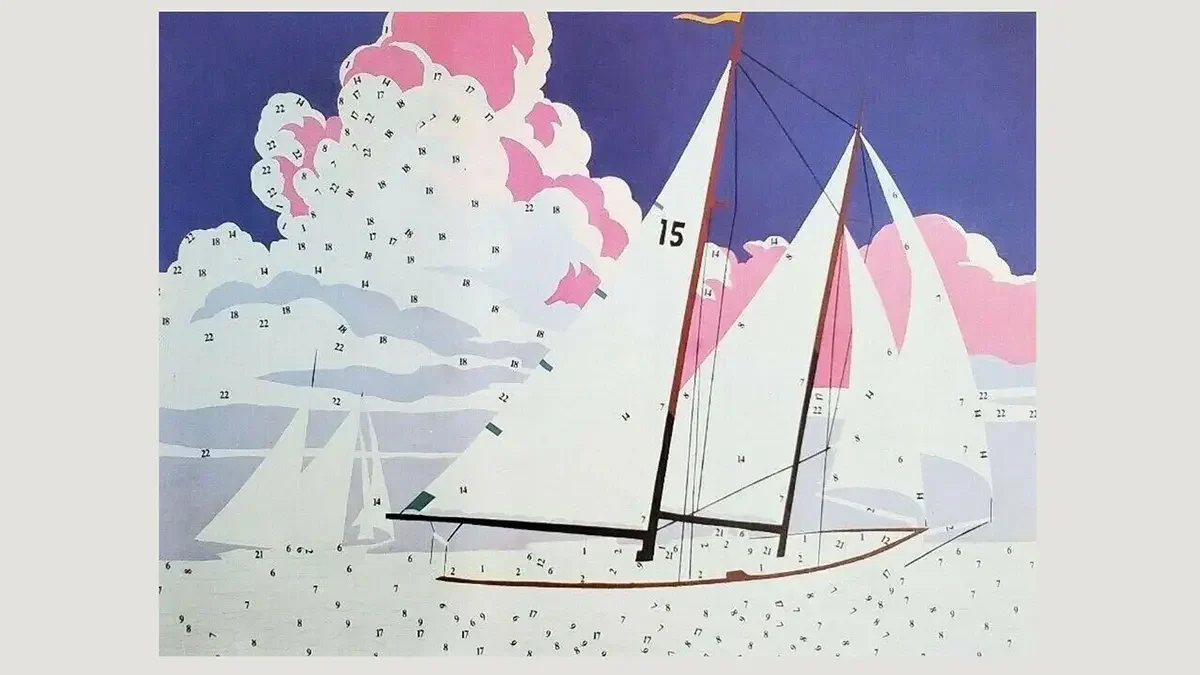
In 1962 Andy Warhol made five paintings he called Do It Yourself, first shown at Stable Gallery in New York. They are based on the paint by number kits that had swept American living rooms the decade before. A landscape, a seascape, a sailboat, flowers, a violin. The numbers are printed on the canvas and large parts of each painting are deliberately left unpainted, so the instructions stay visible.
Here is the detail that matters. MoMA's record of Do It Yourself (Landscape) notes that comparison with the original kits proves Warhol did not confine himself to the colors the kit assigned. He took liberties with the numbers and with the colors. He bought a product that came with instructions, read the instructions, and then did something else.
Warhol gets flattened constantly. The Factory is the thing everyone cites, and it produces the lazy version, the one that begins with Warhol just had assistants make them. Do It Yourself came earlier and it runs the opposite direction. He took a product sold as done for you and made the act of art out of refusing to follow it. The title is the joke, and the joke is on anyone who thinks following was ever the point.
He could depart from the numbers because he could read them. Warhol had spent the previous decade as a successful commercial illustrator, and he knew exactly what a printed instruction was doing and what it was assuming. That is the whole argument of this piece rendered in acrylic on linen. Use the recipe. Understand the recipe. Override the recipe. The order is not optional. I go through this period in the module on postwar art from Paris to New York.
I Bought Presets for Years and They Cost Me Time
I want to be specific about my own record, because the argument I am making would be worthless coming from someone who never tried. I bought presets for years. Cheap ones and expensive ones. Packs from people whose work I admired. In every case the pattern was the same. I would apply the preset to a set of files, the results would be wrong in ways I could see but not name, and I would spend the next stretch of time undoing it.
The undoing was always slower than starting from zero. That surprised me at first and then it stopped surprising me. When I edit from scratch I am making decisions. When I fix a preset I am doing archaeology first and decisions second, because I have to work out what was done before I can work out what to change. A purchased preset arrives carrying tone curve points, hue and saturation and luminance shifts, sometimes calibration moves, sometimes a profile change. Applied to a file shot under different light with a different sensor, a few of those are right and most are wrong, and there is no way to sort them except by zeroing them one at a time and watching. By the time you have finished you have performed the manual edit anyway and paid for the privilege of doing it backward.
The standard rebuttal is that I bought bad ones. I did not only buy bad ones. I bought well made presets from photographers who genuinely know what they are doing, and the physics did not care. A set of numbers derived from someone else's file has no information about my file. That is not a quality problem. It is a category problem, and no amount of craftsmanship on the seller's end can fix it, because the missing thing was never in the file to begin with.
What I Check First When a Preset of Mine Fails
Mine fail too. That is worth saying plainly, because the point of this piece is not that a self made preset always works. It is that when one fails I know where to look.
I check white balance first, because that is what changes most between one room and the next, and a preset built in daylight carries a daylight assumption whether or not I wrote one in. Then the tone curve, because a curve shaped for an open, bright scene will crush a dark one and there is no mystery about why. Then anything sitting in calibration, because that is the layer that assumes a particular sensor rendering and it is the layer that fails silently. Three checks, in that order, usually under a minute.
That works because I am checking a list I wrote. The list is not clever and it is not proprietary. It is just that I know what went in, so I know what can come out. Someone using a purchased preset has the same three problems and no list, which means they are searching rather than checking. Searching finds the answer eventually. It is simply a different activity, and it is the difference between diagnosis and guessing.
This is also why I think the usual technical case against presets misses. People argue that presets break across camera brands, or fall apart under mixed lighting, or force a batch of images into a shape none of them fit. All of that happens. But every one of those failures is repairable by someone who understands the file, which means the technical objections are not really objections to presets. The thing that is not repairable is not understanding the file, and a purchased preset is the only tool I know of that is sold specifically to let you avoid that understanding.
Nobody Profits From Your Becoming Independent
Adams published a method that made his readers not need him. Albers built a course whose successful outcome was a student who could see without him in the room. That is what teaching is. It ends with the other person able to do the thing, which means it ends with you no longer required.
It also does not scale. A class is a fixed number of people and a fixed number of hours, and the only way to teach more is to work more. A preset is a few kilobytes of text. Made once, sold indefinitely, delivered by a server. Those two facts sit at opposite ends of a spectrum, and it should not be surprising that the end which scales has moved into the space where the end that does not scale used to be.
I am not going to lay out that economics here. It deserves its own treatment and it is a different argument from this one. What I will say is narrower, and it is enough. A seller whose product is a file has no incentive to make you independent, because an independent buyer is a former customer. That is not an accusation of bad faith. It is a description of an incentive, and incentives do not need anyone's bad faith to work.
The folder on my drive is not a shortcut. Every file in it is a note I wrote to myself. It says here is what worked, here is where I was standing, here is why. A file I bought says none of that, and it cannot, because it was never addressed to me.
Where This Comes From
History of Photography, Module 08: Modernism, Dada, Surrealism, and the Birth of Fashion Photography
Further Reading
The Museum of Modern Art, Andy Warhol, Do It Yourself (Landscape), 1962
The Andy Warhol Museum, acquisition announcement for Do It Yourself (Sailboat)
University of Arizona, Ansel Adams: Performing the Print, Center for Creative Photography
Sourcing note on the Adams quotation. The wording used above is attributed to The Print (1983), where Adams prefaces it by saying he had often said it. My attribution runs through quotation references citing that book rather than through the book itself, and several looser variants circulate online referring to a composer's score. The substance is not in question. The Center for Creative Photography exhibition listed above was built on this idea and shows multiple prints made from single negatives across his career.
Sourcing note on research method. Several of the sources above were located with AI assistance and then verified against the institutions that hold the work. Readers are encouraged to check them independently. Statements about my own purchasing history, my own workflow, and my own training are first person observations, not sourced claims, and should be read as such.