Aaron Siskind Waited a Decade
to Continue a Conversation
With Franz Kline
In 1961 Aaron Siskind noticed a resemblance between paint marks on a Mexican wall and his friend Franz Kline's paintings on canvas. That idea returned to him a decade later. What that passage of time reveals is a dialogue between two artists who never stopped working the same question, in different materials, whether or not the other one was still alive to answer it.
In 1961, on a trip through San Luis Potosi, Mexico, Aaron Siskind came across a wall marked with random brushstrokes. Something in it reminded him of Franz Kline's paintings, and the idea came to him right there, on the spot: build a photographic homage to his friend. Kline passed away the following year. Siskind did not act on the idea for another decade. In December 1972, on a separate trip through Jalapa, Mexico, he began shooting the series in earnest, eventually working across six locations before it premiered in Chicago in 1975, a few miles from where the Art Institute is now showing the friend who taught Kline how to work at scale in the first place. Call it a tribute if you want. What actually happened in that decade is stranger and more interesting than tribute, and worth taking seriously on its own terms.
A Conversation Picked Back Up,
Not a Reaction to Loss
An immediate response to a friend's death is easy to understand. Grief looks for an outlet, and turning to the person's work, revisiting it, photographing near it, is one of the most natural outlets available. That is not what Siskind did. He let the idea sit for ten years. No anniversary forced his hand. No exhibition deadline pulled the work out of him. He picked it back up on an ordinary trip, to a different Mexican city, for no documented reason beyond his own readiness to return to it.
That timing changes what the work is. A photograph made in the weeks after a friend's death is mostly about the person left behind, an expression of loss with a specific subject attached. A photograph made a decade later, deliberately, without urgency, reads less like mourning and more like resumption, a conversation that had been paused rather than ended. Siskind and Kline had spent years circling the same visual question while Kline was alive. Kline's death did not close that question. It just meant Siskind would have to keep working it alone.
What Six Cities Actually Produced
The Homage to Franz Kline series was not made in one place or in one sitting. Siskind shot it across six locations between 1972 and 1975, each identified by where and when it was made, each with its own character, according to the record held by the Museum of Contemporary Photography at Columbia College Chicago. That structure matters. A single photograph that resembles a Kline painting could be coincidence, or a lucky find. Six deliberate expeditions, spread across years and countries, are the work of someone testing a question from multiple angles, not someone chasing a single resemblance.
Siskind was not solving a problem that belonged to Kline. The two of them had been circling the same visual territory together for years before Kline died: what a gesture means once you strip away everything it was supposed to represent, what an accidental mark and a deliberate one have in common once both are isolated on a flat surface. Kline worked that question in paint. Siskind worked it in photographs of walls that had never been touched by anyone trying to make art. The six cities are Siskind picking the question back up on his own, in the medium that was always his, not finishing something that belonged to Kline alone.
Kline Was Already Chasing This,
With a Projector Instead of a Camera
Kline's own breakthrough came from a version of the same question, arrived at years earlier and by an entirely different route. Around 1949, at Willem de Kooning's suggestion, Kline projected one of his small ink drawings onto a studio wall using a Bell-Opticon enlarger. According to the Guggenheim's account of his career, seeing that small drawing blown up into a large-scale ideogram pushed Kline toward the black-and-white abstractions that would define him. He showed the first of them at the Charles Egan Gallery in 1950, a story corroborated independently by the Whitney and the Met, and he spent the rest of his life working at that scale.
Here is my own observation, not something I found written down anywhere: strip away the art history and what happened in that studio was a photographic event. Light passing through an aperture, projecting a shape onto a surface, is the same basic physics behind a camera obscura, a principle understood centuries before photography existed as a medium. Kline did not need the term to use the effect. Anyone who has spent real time in a room with strong directional light, daylight cutting through a window in the afternoon, or a bare incandescent bulb at night throwing hard, undiffused shadows, has likely watched an object divide that light into shape and shadow without giving it a second thought. It is such an ordinary observation that almost nobody bothers to write it down. Kline's own last studio, according to a history of the space kept by Village Preservation, had large storefront windows specifically for the light his process required. The Guggenheim's account also notes he often worked at night, under strong artificial light. Both kinds of light throw hard shadows. Neither one required him to think about optics to make use of what they did to a room.
The Photograph Lima 89
Was Never Copying
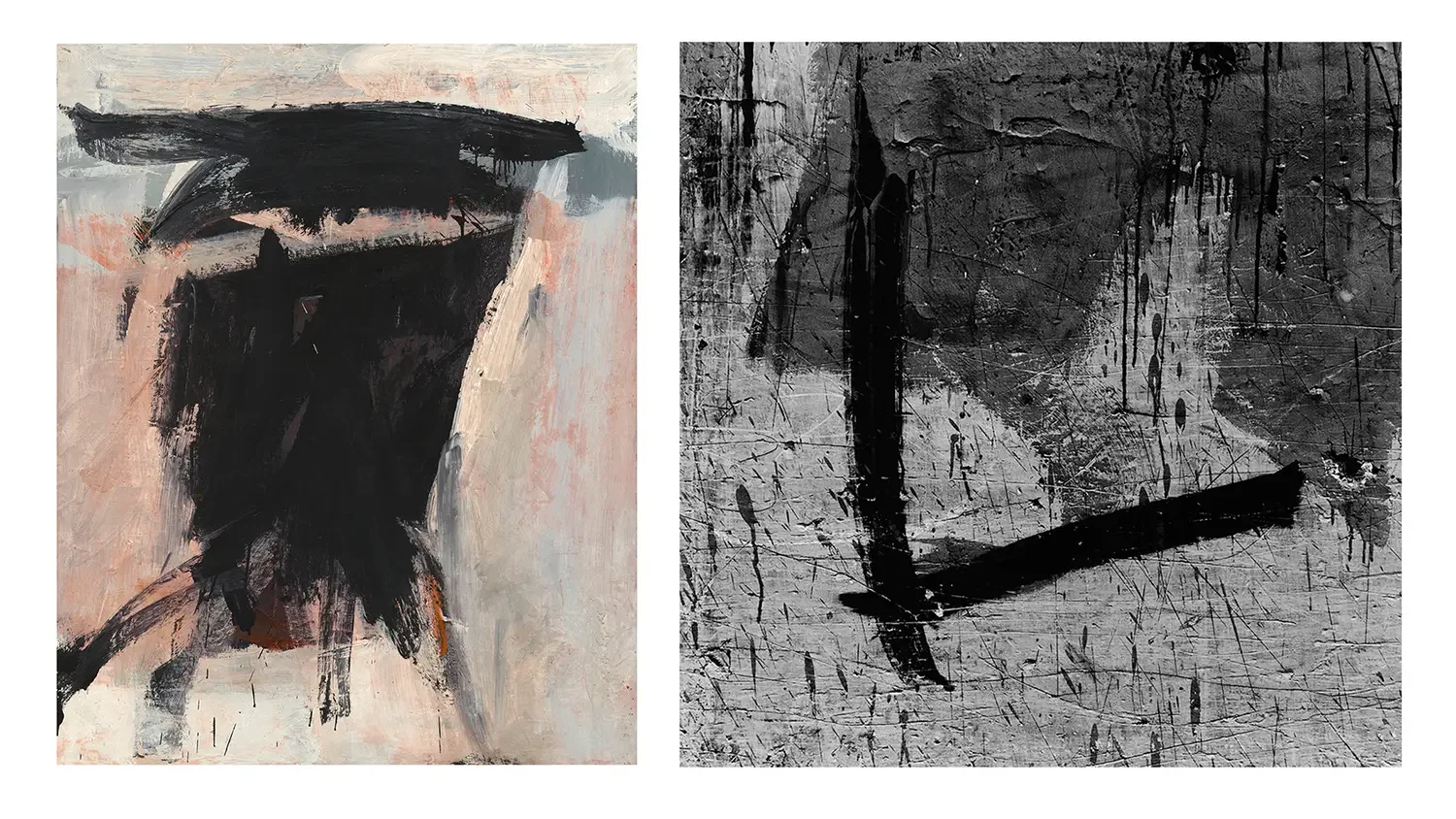
Put Siskind's 1975 print Lima 89 next to Kline's 1958 painting Rose, Purple, and Black and the kinship is immediate: two black strokes forming an imperfect, slanting L, the marks uneven and stray at the edges in both. The Smith College Museum of Art holds both works and has drawn the comparison directly, describing how closely the photograph's structure echoes the painting's.
Siskind did not restage Kline's canvas. He was not standing in a museum with a camera, and there is no evidence he carried a photograph of Rose, Purple, and Black with him to Peru. He found paint on a wall, unrelated to Kline, made by someone with no knowledge of Abstract Expressionism, and recognized in it the same structural decision Kline had made deliberately seventeen years earlier. That is the difference between imitation and continuation. An imitation needs the original in front of it. Siskind needed only the question.
What a Decade-Late Return Is Actually Worth
None of this required grief to be the engine. Siskind's decade of waiting was not indecision or delay, it was patience applied to a question that did not expire when its co-author did. Kline had already shown, with a borrowed projector and a small ink drawing, that this inquiry could move between mediums, from drawing to painting, at any scale, through any tool that happened to be within reach. Siskind picked up the same inquiry with a camera, a decade later, in a country neither man had built his reputation in, and did not need Kline present to keep working it.
The piece that led here argued that documenting an artist's work is not a lesser creative act. This one pushes that argument further: an artist can keep working another artist's question indefinitely, in a completely different material, long after urgency, grief, or the other artist's own life has run out. That is not homage in the greeting-card sense. It is closer to what any two people who have spent years thinking about the same problem actually do when one of them is gone. The thinking does not stop. It just continues in whoever is left holding the tools.
Where This Comes From
History of Photography course outline — where Aaron Siskind's shift from documentary to abstraction is covered, along with the camera obscura principle referenced in this piece.
Modern Art — the New York School and Abstract Expressionism section, general navigation for the movement Kline worked within.
Further Reading
Guggenheim Museum. "Franz Kline." Artist page. guggenheim.org
Whitney Museum of American Art. "Franz Kline." Artist page. whitney.org
The Metropolitan Museum of Art. "Black Reflections." Object page. metmuseum.org
Museum of Modern Art. "Chief." Object page. moma.org
Josef Lebovic Gallery. "Jalapa 66" listing, citing the Museum of Contemporary Photography, Columbia College Chicago. joseflebovicgallery.com
Etherton Gallery. "Aaron Siskind." Biography. ethertongallery.com — Note: gallery-authored biography, used only to corroborate dating already confirmed by the Josef Lebovic Gallery listing and the Princeton University Art Museum object record below.
Princeton University Art Museum. "San Luis Potosi 11." Object record, with the 1961 date inscribed by Siskind on the print itself. artmuseum.princeton.edu
Smith College Museum of Art. "Aaron Siskind and Abstract Expressionist Photography." scma.smith.edu
Village Preservation. "Franz Kline's Last Studio at 242 West 14th Street." villagepreservation.org — Note: used for studio lighting context only, supplementary to the Guggenheim account.
Art Institute of Chicago. "Willem de Kooning Drawing." Exhibition page. artic.edu