How Aaron Siskind
Turned De Kooning's Gesture
Into a Photograph
The standard story says Willem de Kooning inspired photographers from a distance. The record says his closest photographer friends fed the work back into the paintings, and a second friendship shows that documenting an artist was never the lesser art.
Every write-up of the Art Institute of Chicago's new de Kooning exhibition that has crossed my feed this summer repeats the same shape of story about photography and painting. Willem de Kooning and the rest of the New York School worked out something enormous on canvas in the late 1940s and early 1950s, and photographers, watching from outside, learned to see shape and texture instead of subject matter. Painter teaches, photographer learns. It is a tidy story, and it is not the one the record supports. The Art Institute's own Willem de Kooning Drawing exhibition, running through September, is a good occasion to correct it.
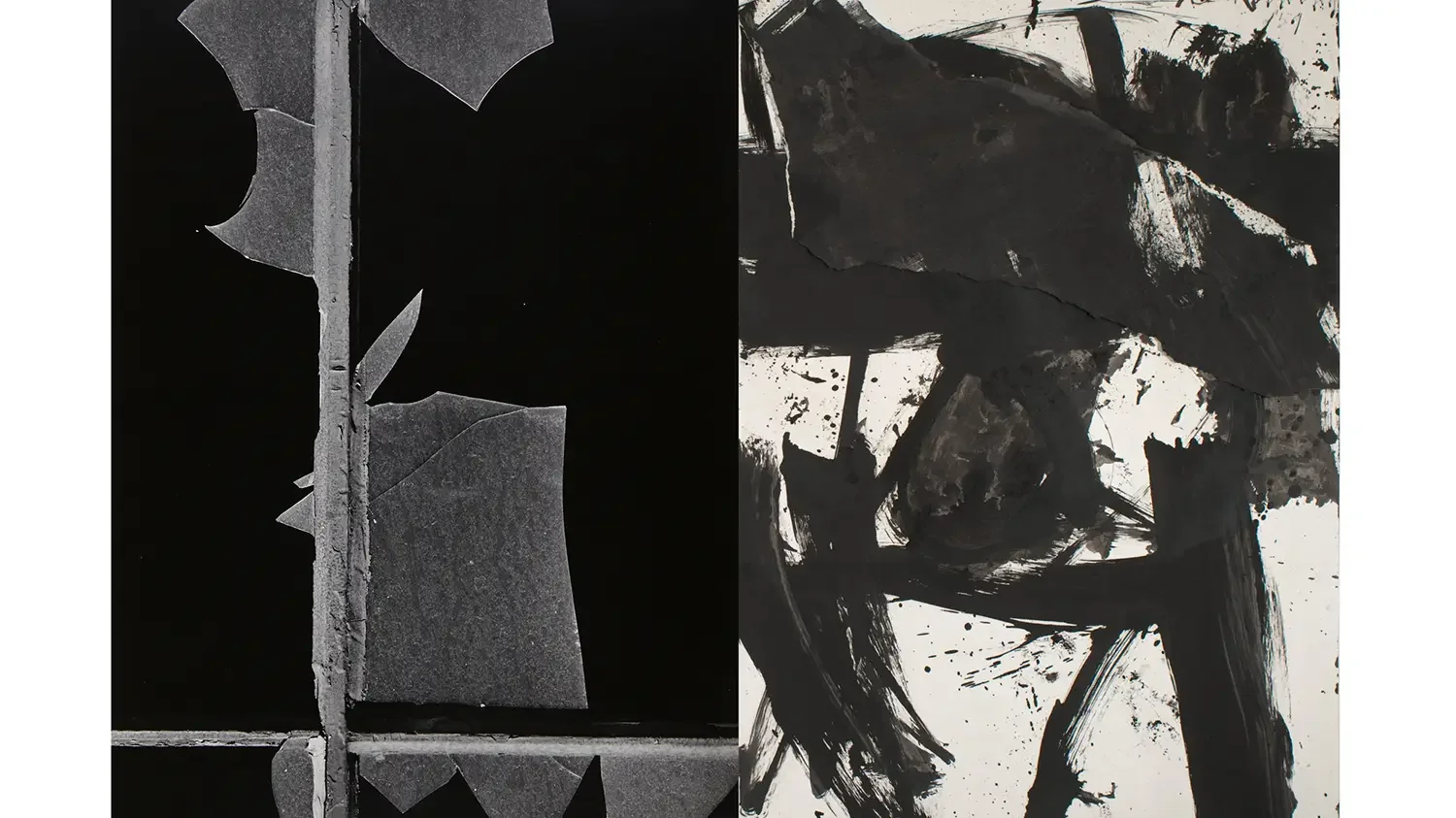
A Friendship the Museum Text Skips
Aaron Siskind was not admiring de Kooning's work from across a gallery. He was inside the circle. By the early 1940s, Siskind had left the documentary photography that made his name at the Photo League and started photographing peeling paint, torn posters, and weathered rock faces as if they were paintings in their own right. That shift happened alongside, not after, his friendships with de Kooning, Franz Kline, Mark Rothko, and Barnett Newman, the painters who would come to define Abstract Expressionism, according to the Whitney Museum's artist page on Siskind. He showed at the Charles Egan Gallery in the same stretch of years Kline had his own breakthrough there. He was not an outside observer taking notes on a movement. He was one of the people in the room while it happened, as TheArtStory's account of his career makes clear.
What Siskind Actually Took From the Painters
The formal borrowing is real and worth naming precisely, because "inspired by" undersells it. Siskind stopped photographing whole scenes and started photographing fragments close enough that scale disappeared. A section of peeling paint, shot tight, reads like a de Kooning brushstroke or a Kline slash, not because Siskind copied a painting but because he trained his eye on the same problem the painters were solving: what a mark means once you strip away everything it was supposed to represent. That is a genuinely different kind of photograph than anything the documentary tradition he came from had produced.
Two-Way Steet:
Artists Influencing Each Other
Here is where the standard account gets thin, and where I want to be careful about what I am claiming. A 2003 exhibition at Andrea Rosen Gallery, built around Siskind's Abstract Expressionist circle, states that details from Siskind's photographs turn up inside de Kooning's own Woman paintings, the same series at the center of the Art Institute's Excavation and Woman I display this summer. I have not found that claim independently confirmed outside gallery material connected to Siskind's own representation, so I am not presenting it as settled art history. But it is documented, specific, and it points at something the one-way version of this story cannot account for: painters who were also looking at what their photographer friend was doing, not just the other way around. If even part of that traffic ran from camera to canvas, the whole "photographer as follower" framing collapses.
Rudy Burckhardt Was Never Just Watching
The second friendship in this story belongs to Rudy Burckhardt, a Swiss-born photographer who moved to New York in 1935 and ended up living next door to de Kooning, according to Britannica's biography of Burckhardt. Their friendship ran for decades, and through the 1950s Burckhardt photographed de Kooning and nearly every other major figure of that circle at work, for ARTnews, for the historical record, for no one in particular, a body of work documented in New York University's Grey Art Gallery program notes. The easy read of that body of work treats Burckhardt as a bystander with a camera, standing next to the real art while it happened a few feet away. That read does not survive contact with what he actually produced. Deciding where to stand, what to include in the frame, when to press the shutter while a painter works, those are not passive acts. They are the same decisions a painter makes about a canvas, applied to a moving, breathing subject who has no idea he is being composed.
What This Means If You Stand Next to the Work For a Living
I do not think this is only an art history correction. If you photograph anything for a living, headshots, weddings, product work, you have probably absorbed some version of the idea that documenting someone else's work or moment is a lesser creative act than making the thing itself. Siskind's borrowed formal vocabulary and Burckhardt's four decades of studio portraits argue otherwise, from inside the exact movement usually cited as photography's teacher rather than its peer. The Art Institute's own de Kooning artist page frames this show around drawings that were not preparation for his paintings but the real work happening in real time. That argument applies just as well to the photographer standing in the doorway of that studio.
Next Up:
The Friend Who Started With a Rocking Chair
There is a third figure in this circle I have not gotten to yet, and his story might be the strangest of the three. Franz Kline was a painter, not a photographer, but his entire signature style, the large black-and-white paintings that read like shadow thrown at full scale, came out of a projector aimed at a small ink drawing of a rocking chair. Siskind was close enough to Kline to spend years after Kline's death photographing graffiti-covered walls in Mexico that reminded him of Kline's brushwork, an entire body of work built as an elegy to a friend's gesture. That relationship, a photographer spending a decade chasing the memory of a painter's mark, is worth its own piece. I will be back with it.
Where This Comes From
History of Photography course outline — where Aaron Siskind and the shift from documentary to abstraction sits within the broader arc of twentieth-century photographic history.
Modern Art — where Willem de Kooning and Abstract Expressionism are covered as part of the New York School.
Further Reading
Art Institute of Chicago. "Willem de Kooning Drawing." Exhibition page. artic.edu
Art Institute of Chicago. "Willem de Kooning." Artist page. artic.edu
Whitney Museum of American Art. "Aaron Siskind." Artist page. whitney.org
TheArtStory. "Aaron Siskind: Photography, Bio, Ideas." theartstory.org
Britannica. "Rudy Burckhardt." Biography entry. britannica.com
New York University, Grey Art Gallery. "Rudy Burckhardt and Friends: New York Artists of the 1950s and 60s." Program notes. nyu.edu
Andrea Rosen Gallery. "Aaron Siskind: An Abstract Expressionist Eye." Exhibition checklist. andrearosengallery.com — Note: this is gallery promotional material tied to Siskind's own representation. Its claim that details from Siskind's photographs appear in de Kooning's Woman paintings has not been independently confirmed elsewhere and is presented in the article above as documented but unverified.
Whiddington, Richard. "Willem de Kooning's Rarely Seen Drawings Come Into Focus in Chicago Show." Artnet News, May 2026.