Thirty Years the Frame, and Now the Picture
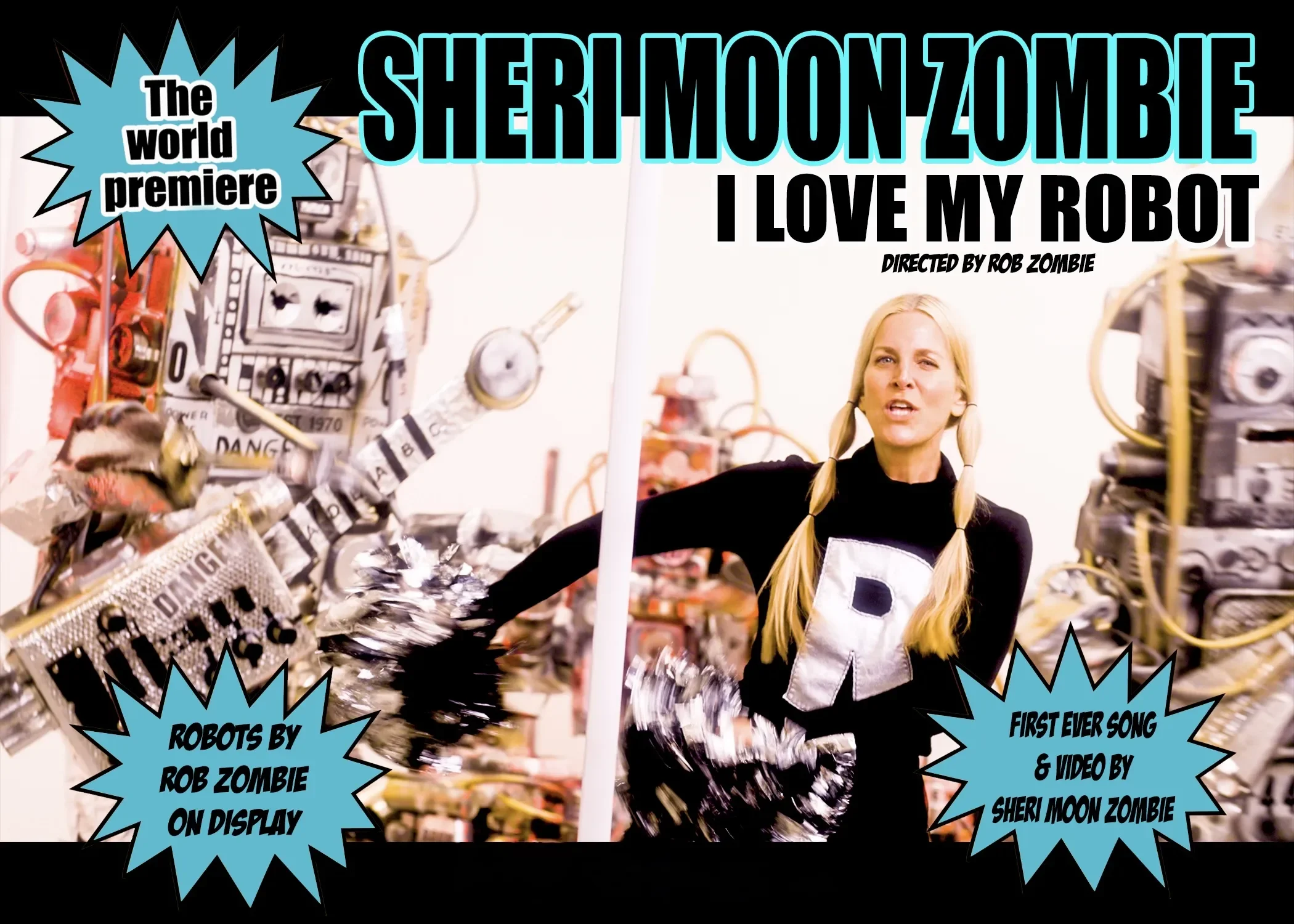
Sheri Moon Zombie's first solo song and video premieres this month at a Connecticut gallery. Read against her actual thirty-year timeline with Rob Zombie, this isn't a new dependency finding its moment. It's a long investment finally getting its own credit line.
Sheri Moon Zombie has spent three decades as the frame around someone else's story: the dancer in his videos, the co-star in his films, the name that follows his in the coverage. This month at Morrison Gallery in Kent, Connecticut, the frame becomes the picture. Her name carries the song. Her voice carries the video, sculpted robots and all. Mary Shelley wrote the structure that horror keeps returning to: starts on one character, and then quietly shines a spotlight on another. That arc is visible across two projects now, four years apart. Read either one in isolation and it looks like doting. Read them together, and it looks like a plan finally reaching its target.
What's Premiering at
Morrison Gallery This Month
The gallery is billing it plainly: the first-ever song and video credited to Sheri Moon Zombie, titled "I Love My Robot," premiering July 24 through 26 with an opening reception on the 24th. The video screens in the gallery's north wing alongside an army of sculpted robots built for the shoot. Rob Zombie directed the video and built the robots. Sheri Moon Zombie's name is the one on the marquee.
Worth noting before anything else: that "first-ever" framing is the gallery's own promotional language, not an independently verified claim, and gallery copy has an obvious interest in billing anything as a debut. It's also not the first time this address has hosted a Zombie name. Rob Zombie had a solo painting exhibition at the same gallery, "What Lurks on Channel X?", from October to December 2025. The venue, the walls, and now the video screen have belonged to him first, more than once.
The Structure Frankenstein Gave Horror
Mary Shelley published Frankenstein in 1818, and the novel's actual shape is easy to forget under two centuries of adaptation: it opens as Victor Frankenstein's story and steadily becomes the creature's. The scientist built something to prove a point about his own genius, and the narrative outgrew him. Wash Shelley writing about the scientist or the creature? Could the creature be seen as some sort of robot? Horror has been rerunning that structure ever since, because it's a genuinely durable one. Somebody builds. What gets built takes the story in its own direction.
That's the lens worth applying here, not as a metaphor for Herman Munster or any other fictional monster, but as a structural pattern for what a creator does across an actual career. Rob Zombie has spent thirty years building stages, videos, films, and now robots. The question worth asking isn't whether he built them. It's who the story ends up being about once he has.
Where the Camera Already Went in 2022
This isn't the first time the pattern showed up. Rob Zombie wrote and directed The Munsters in 2022, casting his wife as Lily Dracula. Multiple reviewers at the time described Lily, not Herman, as the film's actual protagonist, the character driving the plot while Herman, a Frankenstein-styled creation of a side character, supplies the comic relief. That's a note about story structure, not a verdict on anyone's performance, (and this is about the story, not whether or not anyone thought the movie was “good”, the minutae of acting, etc…. it’s about the story).
What is worth noting is a directorial choice several critics flagged independently: the camera's tendency to return to Lily's reactions in scenes that weren't strictly about her. One review called the cumulative effect a "bloated glamour reel." Whatever you make of the film as a whole, that's a director repeatedly pointing his own camera at his wife, four years before he was part of her own song and video. It looks like a pattern, not an isolated instance.
A Hundred-Year-Old Image,
Pointed a Different Direction
The visual language of "I Love My Robot," a woman's likeness built and staged by a man, isn't new. Berlin Dadaist Hannah Höch spent the 1920s cutting up magazines to satirize exactly this anxiety, a Weimar culture unsettled by the "New Woman" and by industrial modernity's habit of rendering women as mechanized, assembled, built. My Modern Art course covers that period and that argument in more depth. Fritz Lang put the same image on screen a few years later with the robot Maria in Metropolis. For a century, the built woman has usually shown up in art as a warning: about control, about substitution, about what happens when a man's hands are the ones doing the shaping.
Morrison Gallery is using the same image toward the opposite end. The robots exist, but the song and the video are credited to her, not shared, not featuring her, they are hers. A hundred-year-old visual trope aimed at diminishment gets pointed, here, at a launch. That inversion is worth naming rather than skipping past, because it's the difference between a director building a monument to his own control and a director building a stage for someone else to stand on.
Thirty Years Before the Robots Existed
Some would dismiss this as a one-off transaction, an established name loaning his platform to a newer one. It’s worth remembering, however, that Sheri Moon Zombie was choreographing routines and building costumes for Rob Zombie's tours back when White Zombie was still touring, in the years before either of them had anything like the audience they have now. She appeared in music videos for his band through the 1990s, married him in 2002, and has spent every subsequent decade inside the same creative operation, on camera and off. Thirty years is not a marketing timeline. It's most of both their adult lives.
That timeline matters because it changes what "he built her a robot" actually means. A newer, one-off collaborator borrowing an established partner's platform is a transaction. What we are witnessing here is a natural part of a decades-long creative creative relationship.
What Compounding Investment Looks Like
Photographers who spend years building a body of work before it pays off in visibility will recognize the shape of this even outside the horror-and-metal world that it's happening in. My Marketing for Photographers course covers this idea directly: a following and a body of trust built slowly compounds in ways a single flashy launch never does. What's premiering at Morrison Gallery isn't a debut built from nothing. It's thirty years of accumulated creative capital, spent all at once, on her.
The Spotlight, Finally
A bass player gets handed a solo after a decade in the rhythm section. A background singer steps up to the mic after years of harmonies nobody named. Those moments only look sudden from outside the band. Sheri Moon Zombie's name on "I Love My Robot" reads the same way from a distance: a surprising pivot, a famous husband's indulgence, a robot built as a gift. Look at the thirty years underneath it and the surprise disappears. What's left is a creator who spent three decades building toward a specific picture, and this month, for the first time, she's the one standing in it alone.
Where This Comes From
Modern Art Module 04: Modernism 1900 to 1945 (Hannah Höch, Dada, and the Weimar-era "New Woman")
Marketing for Photographers (compounding brand equity and long-term positioning)
Modern Art: Complete Course Overview
Further Reading
Morrison Gallery, event listing for "Sheri Moon Zombie: 'I Love My Robot' Music Video Premier"
Wikipedia, "Sheri Moon Zombie"
Wikipedia, "The Munsters (2022 film)"
The Harvard Crimson, review of "The Munsters" (2022)
Culture Crypt, review of "The Munsters" (2022)
Hannah Hoch, German Artist 1889 - 1978
Metropolis by Fritz Lang
Frankenstein, by Mary Shelley