The Apology Was in January.
The Keynote Is in September.
Photographers were angry for about a week in January. The same company now holds a launch event with four working educators on the bill, and that sequence is how something stops being controversial.
At Imaging USA in Nashville this past January, photographers found that Evoto, the AI retouching company many of them had built into their workflow, was running a separate public page offering AI generated headshots. Upload a selfie, receive a corporate portrait, skip the session. The page had pricing, example images, and an FAQ. The anger was immediate and it was loud. Within days the tool was gone and an apology was posted. Then the noise stopped. On September 22 the same company holds a livestreamed product launch, and the four featured speakers on its event page are all described by their teaching credentials. Nothing in that sequence is hidden. All of it is on the record, and I think the sequence itself is the thing worth writing about, more than anything that happened in January.
The outrage lasted a week and then went quiet
The facts are not in dispute, because the company published most of them itself. Evoto's statement said it had missed the mark, that testing a tool which generates images from scratch crossed a line, and that Evoto was built to handle retouching rather than to replace the person behind the lens. The AI Headshot Generator was permanently removed. A company spokesperson later confirmed it was off the roadmap and off all official platforms. Sal Cincotta, a portrait photographer with a large audience and a relationship with the company, posted a video that made the situation public. That is a straightforward account of someone doing the right thing in public, and it should be read that way.
Evoto also offered an explanation, which belongs here so you can weigh it yourself. The company said the page had been intended as a secondary page for search traffic, that it ran on a third party API, and that the FAQ language on it did not match the company's actual practices.
One reported detail deserves more attention than it got. The generator did not require Evoto to train anything, because it was reportedly running on Google's Nano Banana model. The proprietary tool that frightened an industry appears to have been a wrapper around somebody else's API. Hold onto that, because it recurs.
What did not happen next is the part that matters. There was no sustained campaign, no organized withdrawal, no industry body issuing a position. There was a week of anger, an apology, and then the subject closed. Eight months later I could find no follow up coverage at all. A reasonable person could read that silence as the matter having been resolved. I read it as the matter having been absorbed, and those are very different outcomes that look identical from a distance.
I use software I did not write
My position needs stating before this goes further, because it is easy to mistake for a position I do not hold.
I am not against AI tools, retouching software, or automation. I use software I did not write, every day, for work I get paid for, and so does every photographer reading this including the ones who would like to pretend otherwise. I am not calling for a boycott of anything. I do not think the people speaking at this event are villains, and I do not think the engineers building these products get up in the morning intending to hollow out a profession.
The argument is narrower and it is about a structure rather than about anyone's character. When the companies selling tools become the primary place photographers learn, the curriculum quietly narrows to what the tools do. Nobody has to lie for that to happen. It happens because of who is paying for the room.
The reassurance was about the wrong thing
Alongside its apology, Evoto addressed rumors that user photographs had been used as training data. Its promise was that it does “do not use your images or your clients' images to train our AI models.” I have no evidence to the contrary and I am not suggesting any exists. What I want to point out is the shape of the sentence, because this phrasing has become the industry standard reassurance and it is a promise about the wrong object.
Image files were never the valuable thing. A retouching model is not valuable because it has seen photographs. It is valuable because it has extracted the decisions embedded in photographs: where a retoucher stopped smoothing, how far they pushed a warm key, which blemishes they left because leaving them read as skin. The pictures are the evidence. The judgment is the asset.
The closest analogy is not photocopying a blueprint. It is walking through ten thousand finished houses and deriving the blueprint every builder was working from. Nothing is missing from any of the houses afterward. The owners can truthfully be told that no house was taken. And the blueprint is now in circulation, available to anyone, at a price.
A personal workflow that reliably produces a specific look is a professional asset built over years. It is the thing that separates a photographer from a person with the same camera. A promise not to store somebody's files says nothing whatever about that asset, which is why a promise framed that way is not a lie and is not a comfort either.
Fujifilm sponsors World Press Photo
Manufacturer money in photography education is not new and it is not automatically corrupt. Any argument that says otherwise collapses on contact with the actual record, so it is worth being precise about where the line sits.
This year Fujifilm partnered with the International Center of Photography on a national initiative for student photographers in China, with participants selected competitively on portfolio review. Fujifilm also partnered with World Press Photo on a week of workshops at Rencontres d'Arles in July, covering documentary practice, editing, community engagement, and how to prepare work for grants and contests. A camera manufacturer paid for both. Neither program is a product demonstration.
Two things separate that arrangement from a vendor launch event. The institution sets the curriculum, and the sponsor's product is not the subject. At Arles the subject was documentary storytelling, taught by people who do it, in a program World Press Photo designed. Fujifilm's name is on the space. Fujifilm's software is not the syllabus.
That is the test, and it is a usable one. Ask who decided what would be taught, and ask whether the answer to every question in the room is a feature. When the honest answer to the second question is yes, you are at a demonstration, and a demonstration is a legitimate thing that becomes a problem only when it is the main way an entire trade learns.
Every speaker at the launch is billed as an educator
Here is where I have to disclose something. One of the four featured speakers at the September event is Peter Hurley, and I hold a mentor role in the Headshot Crew, the organization he founded. I am not writing from outside this structure. I am standing in it, which is part of why I recognize it.
With that on the table, look at how the event page describes its speakers, in the company's own words rather than mine. Hurley is presented as a Canon Explorer of Light, a bestselling author, and the founder of the Headshot Crew, whose headshot expertise has been taught to global tech companies. Mark Wallace is presented through two decades of lighting tutorials. Lindsay Adler is presented as an educator known for award winning teaching. Francisco Joel Hernandez is presented as a YouTube educator and a brand ambassador for leading photography brands.
Four people. Four descriptions built on teaching. Not one of them is billed primarily as a user of the software, which would be the obvious framing for a product launch. They are billed as the people photographers learn from, and the page invites you to hear from the professionals shaping the company's future.
I want to be careful about what that does and does not show. It shows nothing about anyone's sincerity. Every one of these four is a genuinely accomplished photographer and a genuinely good teacher, and I would say that under oath about the one I know. It also does not show any agreement or arrangement, because I have no knowledge of the terms and would not speculate about them.
What it shows is what the company believes it is buying, and companies are usually honest about that in their marketing because their marketing is aimed at people they need to convince. Evoto is not selling a feature list to engineers. It is presenting a faculty. Eight months after apologizing for a tool that generated headshots without a photographer, it has assembled the teachers, and the photographers who were angry in January will be in the audience learning.
Asset Hub brings the preset store to retouching
The products on the same page are worth reading closely, because two of them are this series' subject arriving somewhere new.
Asset Hub is described as a place to discover ready to use assets and apply them in Evoto. That is a marketplace for finished looks, built into the retoucher, which is the preset economy moving from a scattered cottage industry into a platform with a storefront. And Evoto Video promises to refine portraits, match color, and “apply the look in one click.”
One click. In September 2026. Kodak sold the camera and the processing together in 1888 under the promise that you press the button and someone else does the rest, and the honest thing about that arrangement was that Eastman named the division of labor out loud. I go through that split and the movement that formed against it in the module on Pictorialism and the mass media divide.
The difference is not the automation. It is that the 1888 version told you who was doing the work, and a one click look does not. That is the same objection I would make to a purchased preset, and it does not get smaller when the file is delivered through a storefront by a company whose launch event is staffed by educators.
Normalization is what the silence actually was
The dominant line in online photography education right now is that AI is here to stay and your only real choice is to adopt it or be left behind. I have watched that sentence do an enormous amount of work over the past few years. It is presented as realism, it forecloses the question it appears to be answering, and it is almost always said by someone with something to sell or someone who learned it from someone who did.
Notice the structure of what happened here, because it is a structure and not an incident. Something crosses a line. There is a burst of anger. There is an apology, a withdrawal, and a redirection to the company's real purpose. The anger has nowhere to go, because there was no organized body to carry it and no cost to absorb. Months pass. The company returns with the most trusted teachers in the field standing next to it, and proximity does the rest of the work. Nobody changed their mind. The position simply stopped being a position and became the weather.
That is what normalization is. It does not require anyone to be persuaded and it does not require anyone to act in bad faith. It requires only that the objection is expensive to sustain and cheap to wait out.
This is also not one company's story. Imagen, a competitor, publishes a guide on its own site ranking the best AI headshot software of 2026, and names Imagen the top pick. GotPhoto ran a two day event in Oxford in February billed as a reimagined educational event for school and nursery photographers. Vendors reviewing the category, vendors convening the conference, vendors staffing the faculty. Any one of these is defensible on its own. Together they describe a trade that has outsourced its own instruction to the people selling it equipment, and that arrangement has been building for years. The photographers who used to teach this work independently are still out there. They are just harder to find than a livestream with a registration button, and increasingly the ones who are easy to find are on somebody's bill.
A photographer in the January comments wrote that they had been “funding, training and evangelizing” a piece of software that turned out to be positioned to replace them. That is three kinds of unpaid labor named in a single breath, and it is the most accurate description of the arrangement I have read anywhere. Learning post production from a vendor is not free. It costs the ability to evaluate the vendor, and by the time that bill arrives, the thing you would have needed in order to notice is the thing you traded away. I take that question up further in the module on postmodernism, digital photography, and the smartphone era.
I do not think the September event should be cancelled and I am not asking anyone to skip it. I am writing this before it happens so that it is a position rather than a reaction. Watch it if it is useful to you. Then ask who selected the curriculum, and notice whether any question raised in that room has an answer that is not a feature.
Where This Comes From
History of Photography, Module 06: Pictorialism and the Fine Art vs. Mass Media Divide
History of Photography, Module 12: Postmodernism, Digital Photography, and the Smartphone Era
Further Reading
Disclosure. I hold a mentor role in the Headshot Crew, the organization founded by Peter Hurley, who is one of the four featured speakers at the event discussed above. I have no relationship with Evoto, no financial interest in any company named here, and no knowledge of the terms of anyone's participation.
Sourcing note on attribution. Descriptions of the September event, its speakers, and its products are taken from Evoto's own public event page as it read in September 2026, and event pages change. Descriptions of the January events come from Evoto's published statement and from press coverage. The report that the generator ran on a third party model is DIYPhotography's, attributed there rather than independently confirmed by me.
Sourcing note on what is argued and what is not. I make no claim that Evoto trains on user images; the company states it does not, and I have no evidence otherwise. The argument in the section on training concerns the scope of that category of promise across the industry, not any company's compliance with it. I make no claim about anyone's motives, agreements, or compensation. Everything asserted here about people is a public act with a date attached.
Sourcing note on research method. Sources were located with AI assistance and checked against the originating organizations. Readers are encouraged to verify independently. Statements about my own affiliations and my own practice are first person observations.
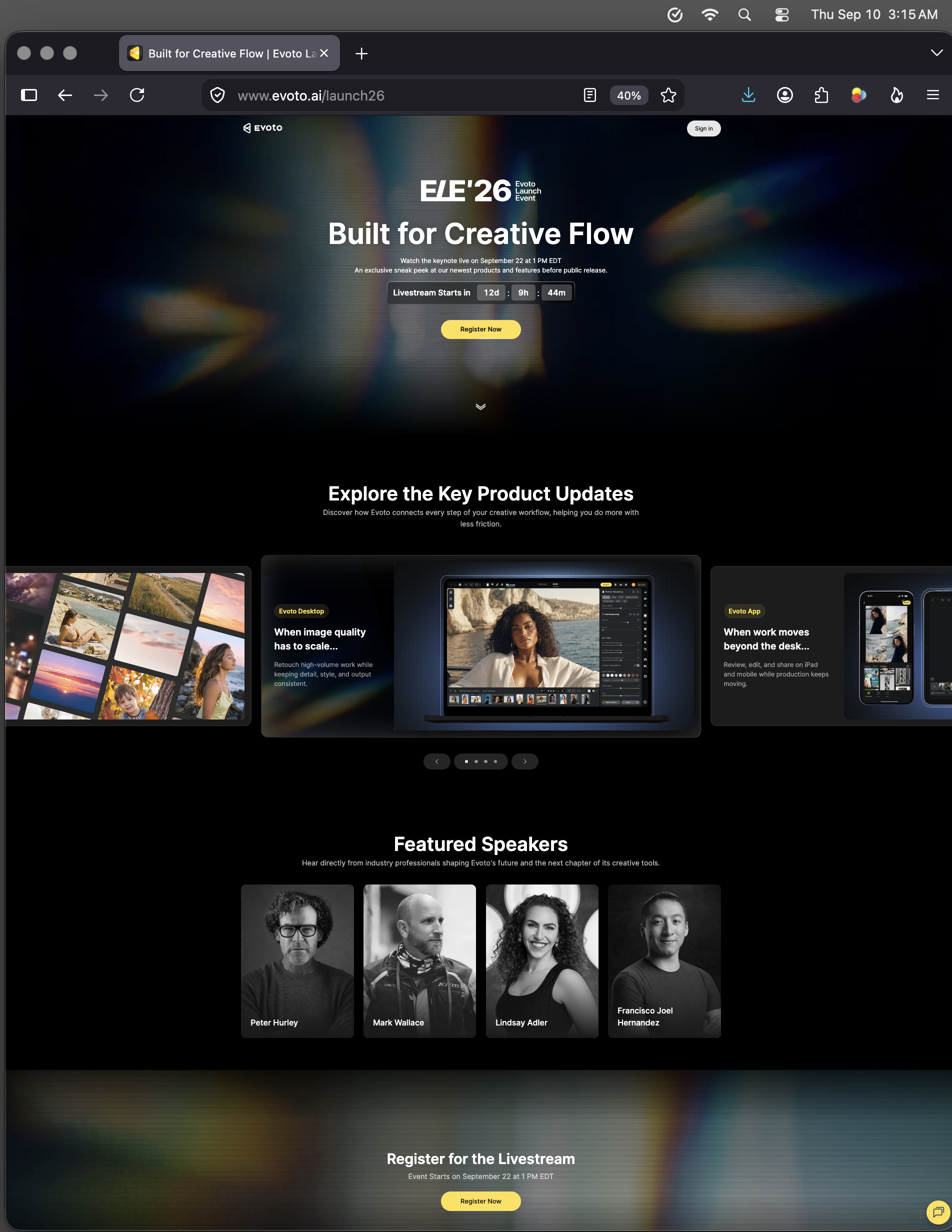
Figure 1. Screen capture of Evoto's "Built for Creative Flow" launch event page, evoto.ai/launch26, captured 10 September 2026 at 2:14 p.m. EDT by Scott Parker. Source of the speaker and product descriptions quoted in this article. Page content is subject to change.