What Avedon's White Background
Strips Away, and What It Can't
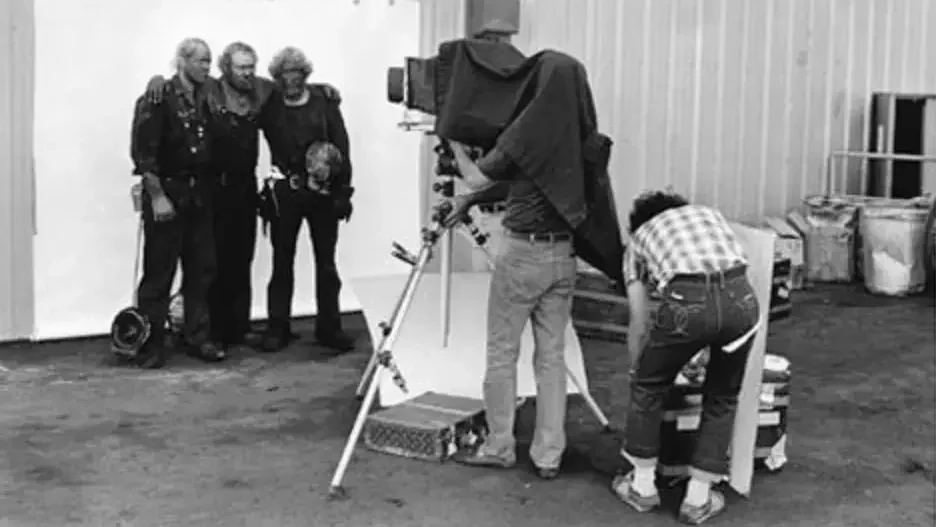
Ron Howard's new documentary wants Richard Avedon's white background to be a moral achievement. Strip away the studio, the props, the environment, and what's left is the person: "without the sense of artifice," in Avedon's own words. I don't think that claim holds up. But the idea underneath it is better than the claim made for it, and the two are worth separating instead of collapsing into a verdict.
The Genre Avedon Was Actually Arguing With
Start with what "artifice" meant inside the profession, not what it sounds like in a documentary voiceover. Portrait photography had a deliberate relationship with props and environment from its first commercial decade. By the 1840s, daguerreotype studios were already adding painted backdrops, head braces, and staged props, coaching expressions and composing within the frame to produce a specific version of the sitter. Southworth and Hawes, Boston's premier studio of the period, were explicit that the job was not to record nature but to invent truth, to produce the version of the sitter that ought to exist. That instinct never went away. It became a discipline.
By the twentieth century, it had a name and a master practitioner. Arnold Newman is generally credited as the photographer who articulated and popularized environmental portraiture, using a carefully framed and lit setting, and everything in it, to symbolize the subject's life and work. His 1946 portrait of Igor Stravinsky, shot on assignment for Harper's Bazaar, is the textbook case: the composer seated at his grand piano, the lid cropped and lit against a plain wall so it reads as an abstract musical note hanging over him. Newman didn't find that note sitting in the room. He built it: angle, crop, lighting, the decision to let a piece of furniture carry the entire argument of the photograph. August Sander was running a related but distinct version of the same logic in Weimar Germany around the same period, photographing ordinary Germans in the actual clothing and tools of their occupations as a systematic sociological survey. The environment and costume weren't symbolic flourish. They were the data.
That's the tradition. Environmental portraiture and occupational documentation both treat clothing, props, and setting as signposts doing real identifying work, on purpose, before the viewer's eye ever reaches the face. It's not a cheat. It's a legitimate, powerful tool, and it's the foundation of most branding and commercial portrait photography still practiced today. Photograph the chef in whites in a stainless kitchen, the founder at a whiteboard, the coal miner with a headlamp in front of a mineshaft, and the surroundings do the identifying work before anyone reads an expression.
I think this is the specific convention Avedon was actually talking back to when he talked about artifice, not artifice in some vague, general sense, but this exact tradition, the one Newman had spent a career refining and Sander had spent a career systematizing. Avedon's real question, asked seriously and worth taking seriously, was how much of that signaling could be removed before finding out what, if anything, was left of the person once the signposts were gone.
The Costume That Replaces the Costume
Here's where I think the documentary's larger claim breaks, and it's a more interesting break than a simple "he failed." Avedon didn't empty the frame. He swapped one signifying system for another.
The white background isn't neutral. It's a specific, recognizable visual register, the one Avedon spent two decades building inside Harper's Bazaar, where his fashion work got its charge from movement rather than stillness, fashion treated as action rather than display. That register carries its own connotations by the time he points it at a coal miner: high production value, magazine-grade lighting and printing, the visual grammar normally reserved for movie stars, presidents, and revolutionaries. Remove the mine, the helmet, the coal dust as narrative prop, and you haven't subtracted signaling. You've replaced occupational signaling with celebrity signaling. The coal miner didn't lose his costume. He got handed someone else's: Avedon's own, the one built for sitters who were already famous before they ever sat down.
This tracks with what fashion photography had already established as its operating premise, well before Avedon's career: the image was never built on documentary's claim to simply record what was already there. Its job was to construct, and it worked because of the quality of the decisions behind the construction, not because the construction disappeared. The white background is a construction. A very good one, refined over decades of magazine work. Just not the absence of one. And not, by extension, the absence of artifice it was sold as.
The Argument Is Circular, and That's Fine
I want to sit with the circularity instead of resolving it, because I think the circularity is the actual finding, not a flaw in the argument.
Avedon removes the coal mine to test whether the man is enough on his own. The answer the photograph gives back is: not without something. He fills the resulting emptiness with a different, equally constructed signal: the studio apparatus of fame and fashion. That refills the frame with exactly the kind of built signification he set out to test the removal of. Round and round. But notice what the loop actually demonstrates: there may be no fully unsignified version of a person available to a camera at all. Every photograph carries some system of signs: occupational or celebrity, environmental or formal, Newman's piano lid or Avedon's seamless paper. The white background doesn't get you outside that condition. It just changes which system of signs you're standing inside.
That's not a "gotcha," and it's not unique to Avedon. Group f.64 ran into a version of the same wall a generation earlier with what they called straight photography: sharp focus, full tonal range, nothing touched in the darkroom, presented at the time as a kind of honesty. It was a real discipline. It produced extraordinary pictures. It was also not the absence of construction; it was a different, more rigorous construction, and the photographers who built that discipline understood the distinction better than the critics who later moralized it into a claim about truth. Avedon's white background runs the same move a generation later, aimed at the studio instead of the darkroom, at occupational signifiers instead of darkroom manipulation.
What the Swap Actually Buys
None of this makes the swap meaningless. Borrowing the visual register usually reserved for the powerful and pointing it at a butcher or a waitress is a real rhetorical act. It says something about who normally gets treated with this kind of formal seriousness, and that observation is worth making on its own terms. That's a claim about representation and hierarchy, and a defensible one. It's a different claim, though, than "I removed the artifice and found the truth underneath," and the two shouldn't get to borrow each other's evidence. The first is an argument about which subjects get the high-production treatment. The second is a claim about unmediated access to a person. Avedon's pictures can support the first. They can't support the second, no matter how long he made someone stand on the paper.
The underlying question is still a genuinely good one for any working photographer, branding or otherwise: how much of what you're calling a person's identity is actually being carried by the props you put around them, and what's left when you take the props away? Based on what Avedon's own pictures show, my answer is: something is left, but it isn't unsignified. It's reassigned. That's a real, useful, photographable distinction. Newman built his career proving that environment can carry the argument of a portrait. Avedon built a project proving that removing the environment doesn't get you out of the argument. It just relocates it to the studio apparatus itself. Both are legitimate findings about where meaning in a portrait actually lives. Neither one gets you to a prop-free truth.
Two Claims, Not One
Avedon was onto something real about props, signifiers, and how much identity-work an environment is doing in a portrait before the subject's face ever enters the conversation. The white background is a serious, well-executed answer to that question. Newman's environmental portraiture and Avedon's elimination of it are two ends of the same argument about where a portrait's meaning actually lives, and both ends deserve to be taken seriously as craft, not ranked against each other as more or less honest.
Where the documentary's claim breaks is the leap from "I changed which visual system is doing the talking" to "I removed the talking altogether." Those are different achievements, and only one of them happened. Howard's film wants the second one, because it's the more inspiring story to tell inside a documentary about a father trying to truly see his son and a son trying to truly see his father. The first achievement is the one Avedon actually earned. It's a sharp, fully realized formal argument about portraiture, made by someone who understood exactly how constructed every version of a person in front of a camera is going to be, including his own. It doesn't need the moral upgrade. It was already enough.
Reference Links
CNN, "Ron Howard's new film on famed photographer Richard Avedon" (May 2026), the source article: https://www.cnn.com/2026/05/18/style/ron-howard-film-photographer-richard-avedon
Richard Avedon, "In the American West," Amon Carter Museum of American Art (artist page and commission history): https://www.cartermuseum.org/artists/richard-avedon
Arnold Newman and environmental portraiture, including the 1946 Igor Stravinsky portrait, Wikipedia: https://en.wikipedia.org/wiki/Arnold_Newman
August Sander, "People of the Twentieth Century," The August Sander Project, MoMA: https://www.moma.org/calendar/programs/113
Southworth and Hawes, Boston's daguerreotype studio, The West End Museum: https://thewestendmuseum.org/history/era/west-boston/southworth-hawes-early-photography-in-boston/
Group f/64 and the "straight photography" manifesto, Wikipedia: https://en.wikipedia.org/wiki/Group_f/64
History of Photography, Module 11: Cold War Photography, Street Photography, and the Rise of Color: https://www.scottparkerphoto.com/history-of-photography/11-cold-war-and-street-photography
History of Photography, Module 09: Documentary Photography, the FSA, and World War II: https://www.scottparkerphoto.com/history-of-photography/09-documentary-and-fsa