The Two Kinds of Important:
Why Edward Steichen Keeps Getting Written About
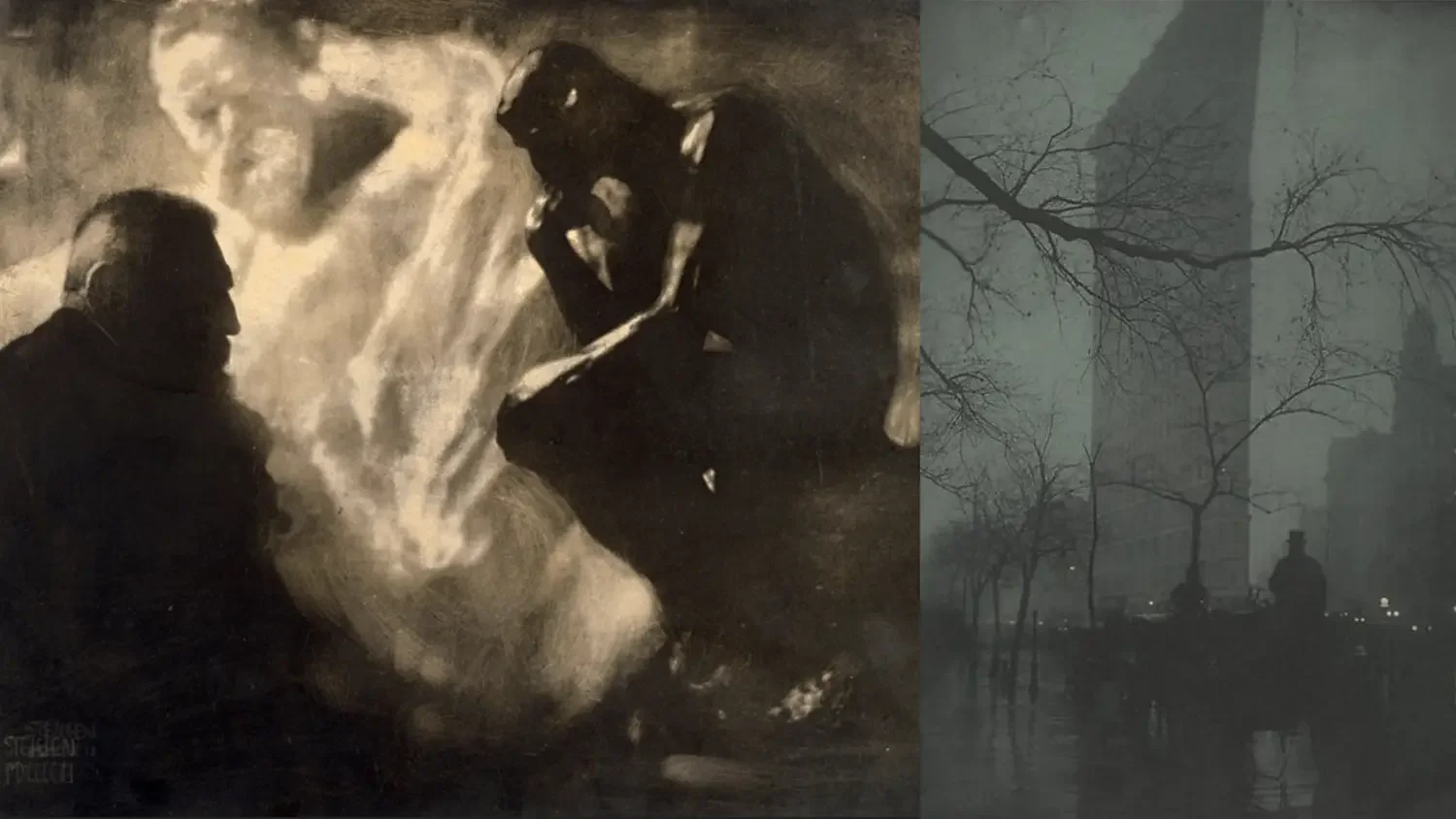
Rodin, Le Penseur & The Flatiron Building
Two Ways Into The History Books
Photographers, art historians, and critics keep coming back to Edward Steichen. He doesn't carry the instant name recognition of Stieglitz or Avedon, and he was rarely the best person working in any single moment of his own career. And yet the writing on him never stops: biographies, retrospectives, footnotes inside arguments that on the surface have nothing to do with each other. That pattern is worth taking seriously, because it points to a question most histories never answer directly: why does anyone end up in the books in the first place?
There are two ways in. The first is singular achievement: Daguerre announces a working process in 1839, Lange photographs a migrant mother in 1936, and the historical job is done in one paragraph, footnoted, finished. The second is the through-line: a career restless enough that it keeps reopening the same arguments the medium itself never settled, showing up at the start of the next one before the last one is even closed. Steichen is the second kind. His career has real, load-bearing presence in twelve of the recurring arguments that organize the history of photography and the history of modern art, not as a passing reference in any of them, but as a primary case. What follows traces that career in order, the way it actually happened.
1900 to 1910:
Proving a Photograph Could Be Art
Pictorialism, Photo-Secession, the Modern Art question
He shows up first around 1900, when a twenty-one-year-old Stieglitz protégé became one of the founding voices arguing that a photograph could be judged by the same standard as a painting. Soft focus, gum-bichromate printing, deliberate manipulation of tone and texture: the goal wasn't documentation, it was proof that the camera could produce something with the emotional weight of art. Two years later he helped found the Photo-Secession with Stieglitz, the formal organization built around that exact claim. This is the foundation of Pictorialism and the Fine Art vs. Mass Media Divide.
That same decade-long body of work answers a separate question being asked on the painting side of the divide. If photography could now describe the visible world with total mechanical accuracy, painters had to find something else to do, which is the actual founding tension of modern art as a category. Steichen's own Pictorialist prints are an inconvenient complication to that tidy story: a photograph trying, and largely succeeding, at doing exactly what painting was supposedly retreating from. He's present at the start of the very question What Is Modern Art? raises.
1904 to 1918:
Paris, the Avant-Garde, and a War
Flatiron, Rodin/Cezanne, Picasso/Matisse, WWI
In 1904 he turned his camera on the Flatiron Building, then one of the tallest structures on earth and a working symbol of unapologetic industrial ambition. Where Jacob Riis and Lewis Hine were photographing tenements and child laborers to provoke outrage at the same moment in the same city, Steichen pointed his lens at capital itself and made it look like a dream: a wash of dusk light and soft atmosphere around a brand-new kind of building nobody had decided yet how to feel about. Two photographers, same skyline, opposite instincts, and both readings belong to Social Reform, Science, and the Modern City.
By the late 1900s he was spending long stretches in Paris, where he photographed Auguste Rodin, absorbed the dream logic of Symbolist poetry, and used his connections to get European modernists in front of an American audience that had never seen their work. Through the 291 gallery he ran with Stieglitz, he personally arranged the first U.S. exhibitions of Rodin's drawings in 1908 and Cézanne's paintings in 1910, both names anchoring Impressionism, Post-Impressionism, Symbolism, and Art Nouveau.
The same gallery, around the same years, gave Picasso and Matisse their own first American exposure, which means Steichen had a hand in importing the exact avant-garde that would soon make his own Pictorialist style look sentimental by comparison. He didn't resist that verdict. After serving in World War I he abandoned painterly photography outright and adopted what he called straight photography (sharper, harder, stripped of soft-focus mood), a personal correction that plays out the larger argument of Modernism 1900 to 1945 inside one career.
The war that pushed him there is its own chapter. In 1917 he was commissioned to head aerial photographic reconnaissance for the American Expeditionary Forces in France, directing a unit responsible for mapping enemy positions from the air. It was a different kind of war photography than the battlefield work of the previous century, technical and procedural rather than eyewitness, and it's part of what belongs to War, Imperialism, and Photography as a Social Force.
1923 to 1947:
Betting on Commerce, Then a Museum
commercial pivot, fashion photography, WWI, FSA, MoMA appointment
What he did with that hard-edged new style afterward is the more surprising turn. Rather than treating commercial work as beneath the seriousness he'd spent fifteen years building, he opened a studio in New York in 1923 and made the opposite bet entirely: that commerce could be the more honest application of a modern aesthetic than fine-art galleries ever were. It's the same argument the carte-de-visite era had picked a fight over decades earlier, just resolved the other way, and it sits at the center of Art vs. Commerce and the Rise of High Art Photography.
That studio became the most influential commercial photography operation of its era. As chief photographer for Condé Nast from 1923 to 1938, shooting for both Vogue and Vanity Fair, Steichen photographed Gloria Swanson, Greta Garbo, and Charlie Chaplin using the same geometric clarity and dramatic studio lighting the European avant-garde had been developing in galleries, and is widely credited as the person who turned fashion photography into a recognized commercial category in the process. The advertising and fashion industries didn't discover modernism on their own. He brought it to them, which is the entire premise of Modernism, Dada, Surrealism, and the Birth of Fashion Photography.
He closed that studio in 1938 and four years later was back in uniform, this time commissioned as a Navy lieutenant commander directing the photographic record of the war in the Pacific and overseeing the unit responsible for the documentary footage that became The Fighting Lady. Two decades after that, as a museum curator rather than a combatant, he reached back into the same period from the other side, compiling the Farm Security Administration's Depression-era archive into the retrospective exhibition The Bitter Years, meaning he shaped how this era gets remembered twice, once as a participant and once as its editor, both belonging to Documentary Photography, the FSA, and World War II.
In 1947 he took the job that did the most lasting damage to the idea that he was primarily a photographer at all: Director of the Department of Photography at the Museum of Modern Art. The appointment landed at the exact moment New York was absorbing the role Paris had held in the art world for a century, and Steichen's program at MoMA was part of the institutional machinery that made the shift permanent rather than temporary. He stopped making his own pictures almost entirely. The job from here on was deciding whose pictures mattered, which is the quieter half of Post-War: From Paris to New York.
1947 to 1962:
The Exhibition and the Quiet Kingmaker
Family of Man and the curatorial bets
The most visible proof of what that job let him do arrived in 1955, when he curated The Family of Man: 503 photographs from 273 photographers across the world, built around the premise that human experience held more in common across cultures than it held apart. It toured thirty-seven countries, drew more than nine million visitors, and remains the most attended photography exhibition ever staged, along with the most argued-about, since critics have spent seventy years accusing it of flattening real political and historical difference into comfortable sentiment. Whichever side of that argument you land on, the show itself is the entire reason From Universalism to Cultural Relativism, 1945–1975 still gets argued over.
Running underneath that signature exhibition was fifteen years of quieter curatorial bets that did just as much to decide who the postwar era would be remembered by. In 1952 he bought two Robert Rauschenberg prints before any other museum had shown interest. He gave early exhibition space to Harry Callahan and Aaron Siskind, and he was championing Robert Frank's work before The Americans had even found a publisher. None of it was his own photography. All of it was taste exercised from the inside of the institution that got to decide which names from this period would stay in circulation, which is exactly the mechanism behind Cold War Photography, Street Photography, and the Rise of Color.
What This Actually Proves
That's the full arc, and it's worth being honest about what it does and doesn't prove. Steichen was rarely the best photographer working in any single one of these moments. Stieglitz has a stronger claim to Pictorialism. Frank has a stronger claim to the postwar street. He isn't written about this often because he won twelve arguments. He's written about this often because his career kept landing at the hinge point of whatever argument photography was having next, on whichever side of it turned out to matter, which is a different, more durable kind of importance than being the best, and the one that actually explains why a single name keeps surviving every retelling of this history.