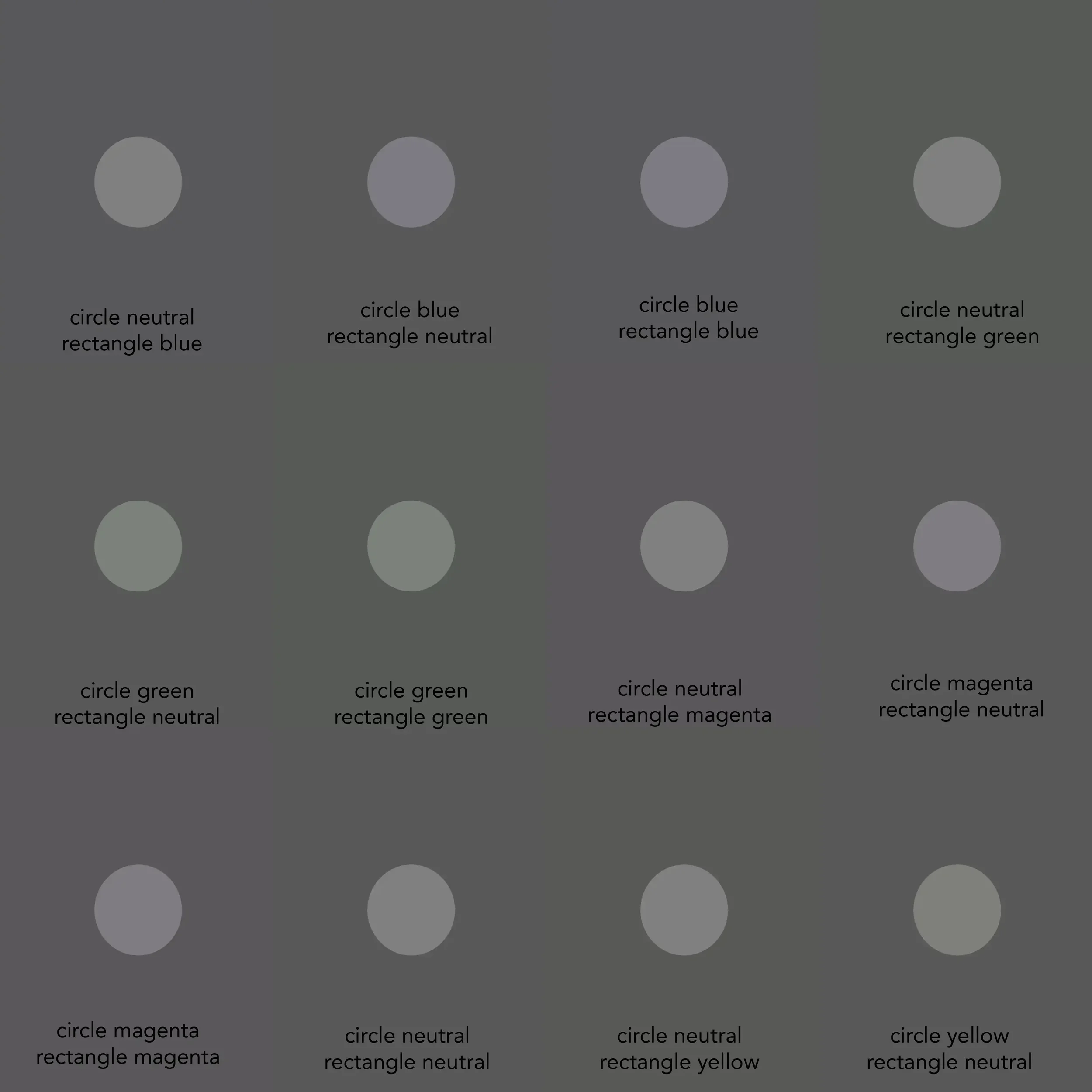
Finding Neutral Gray
Color looks different, depending on the color is is next to. It's often a relative shift, and not always reflected color contamination. Look at the first image. It contains 12 fields, each with a circle in the center. Only one contains a neutral gray background and neutral gray circle. Can you find it?
Remember, color is a model, so we can discuss what we are seeing.

The challenge to this exercise is that, because we are not machines, we perceive color differently based on adjacent colors.
We can use a machine to establish absolutes.
But, if I were to draw a parallel between our human visual system,
and that of a digital camera,
our vision is always set on Auto White Balance.
It tries to get it right, but the entire environment influences it.
This might balance the overall picture,
but it could be at the expense of specific colors.
Next, let’s have some fun and look at the blocks one at a time.
See if you can spot the neutral one.









It was a trick.
None of the individual images were neutral.
Some had a color shift in the background.
Some had a color shift in the circle.
Some had a color shift in both.
The neutral one will appear below this text.